






What Netsuite fixed asset management can do for your business
NetSuite Fixed Asset Management gives you complete visibility and control over your entire asset lifecycle, from acquisition and depreciation through to disposal. This comprehensive solution eliminates the inefficiencies of spreadsheet-based tracking by automating depreciation schedules, ensuring accounting compliance, and connecting your asset data directly to your financials within one powerful, cloud-based ERP system.
-
Get a NetSuite pricing estimate
Let Annexa, Australia and New Zealand’s most experienced NetSuite implementation partners, prepare a tailored pricing estimate for your organisation.
Core features of Netsuite fixed asset management
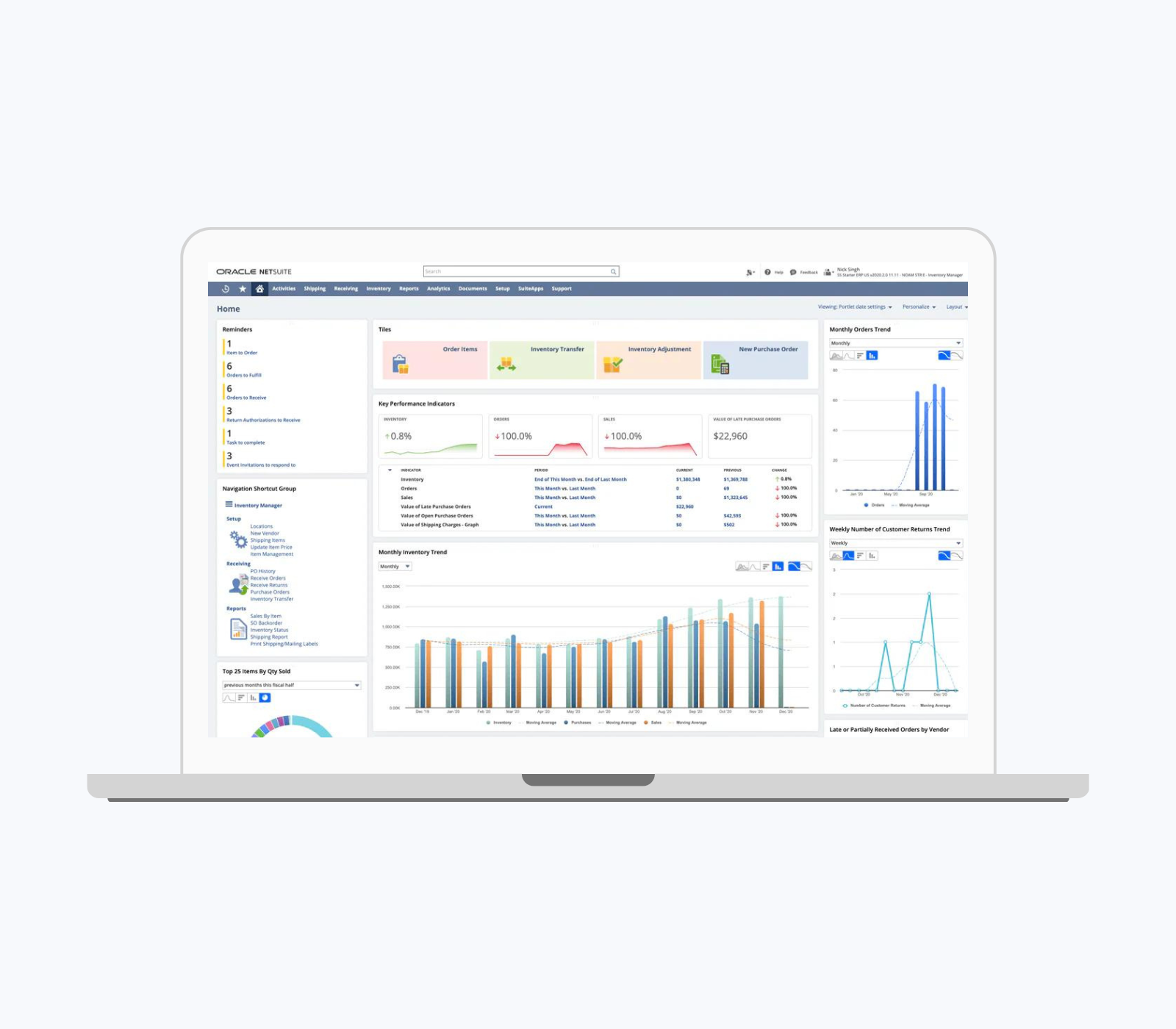
All part of a complete modern cloud ERP suite
-
One unified suite
One complete system to run every facet of your global organisation.
-
Real-time visibility
View business-wide financials, from summary levels down to individual transactions.
-
Intuitive experience
A simple to use and understand platform, easily customisable for user preferences and roles.

Who is NetSuite Fixed Asset Management for?
NetSuite Fixed Asset Management is designed for Australian and New Zealand businesses that carry a material asset base and need a more reliable, less manual approach to asset tracking and depreciation.
-
Finance teams currently managing depreciation in spreadsheets.
-
Asset-intensive businesses in industries such as construction, manufacturing, transport, mining, hospitality.
-
Businesses with significant capital expenditure programs.
-
Businesses preparing for audit or operating under external financial reporting obligations.
-
Companies reporting under IFRS requiring compliant asset depreciation and fair value accounting.
-
Multi-entity businesses that hold assets across several subsidiaries.






Why choose Annexa?
At Annexa, we combine deep Oracle NetSuite ERP expertise with a practical, people-first approach. We work alongside your team to deliver implementations that are built to last and designed to evolve as your business grows and as automation and AI capabilities become part of the platform.
- Over a decade as a leading Oracle NetSuite Solution Provider across Australia and New Zealand
- Proven delivery across complex ERP implementations, integrations and multi-entity environments
- A structured implementation methodology shaped by real-world customer outcomes
- One of the most highly certified NetSuite teams in the region, spanning finance, technical and integration specialists
- Ongoing optimisation and AI advisory services to help customers keep extracting value from NetSuite
Collaboration sits at the centre of how we work. We build long-term partnerships with our customers, acting as an extension of their team to support growth, change and continuous improvement.
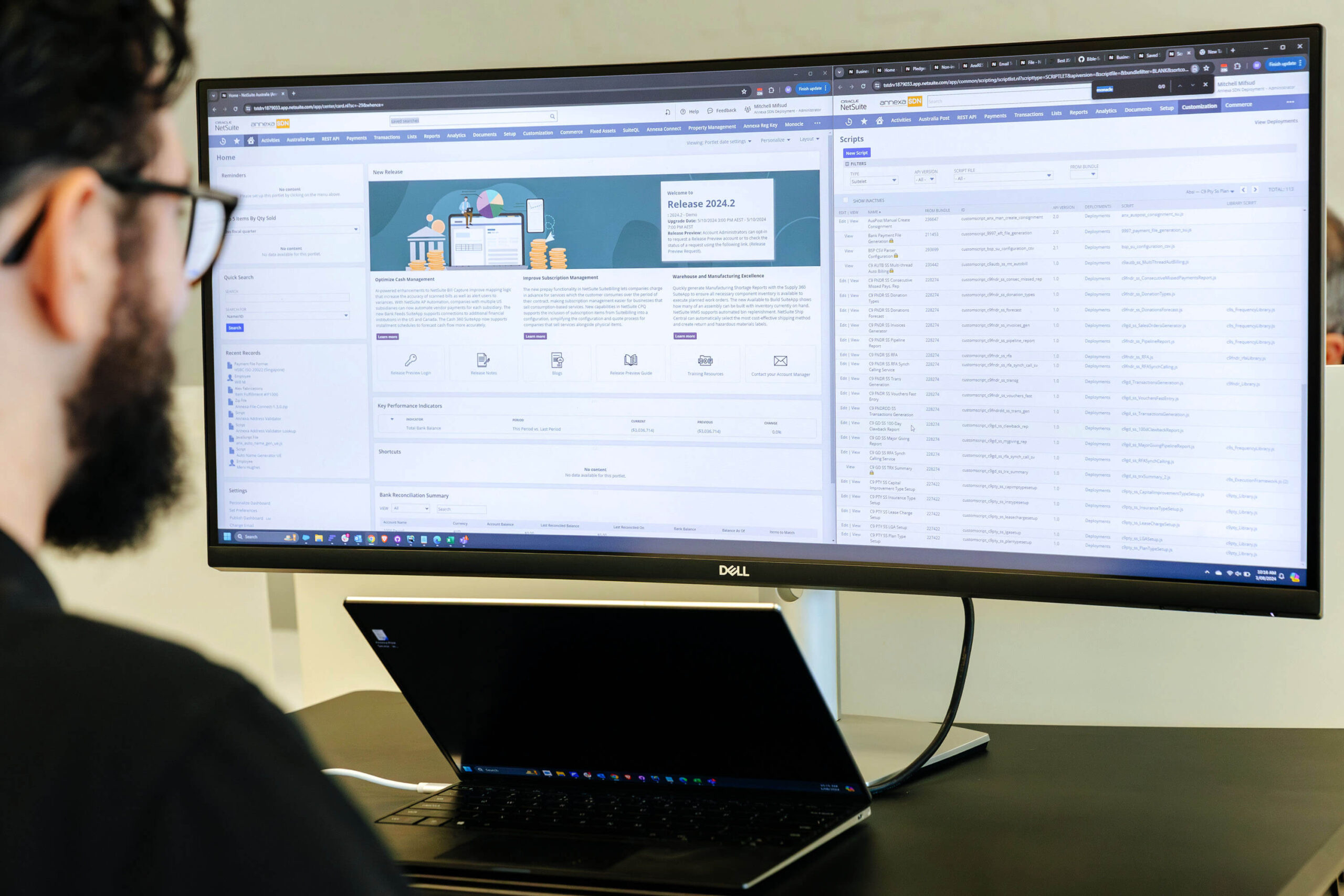

Annexa implementation frameworks and strategies
Annexa uses a proven phased implementation methodology designed to minimise disruption and maximise adoption across your organisation.
We begin with core financials and ERP fundamentals before layering in advanced global features. Throughout the process, our team handles change management end-to-end: user training, process documentation and ongoing support to ensure a smooth transition across all entities.
Annexa is ANZ’s most certified NetSuite implementation and systems integration partner, delivering structured, low-risk implementations backed by deep local expertise.





Get a personalised NetSuite pricing estimate
Receive a tailored NetSuite quote based on your business requirements, users, modules and implementation needs.
Industries we work with
RESOURCES
NetSuite case studies
Frequently asked questions
Standard NetSuite supports single-entity operations, whilst NetSuite global business management (OneWorld) provides multi-subsidiary support, automated financial consolidation, advanced multi-currency capabilities, and built-in global compliance features. Global business management is essential for companies with multiple legal entities or international operations.
NetSuite supports a range of depreciation methods including straight-line, diminishing value, sum-of-the-years-digits, units of production, and manual depreciation. Multiple depreciation books can be configured for each asset, allowing separate calculations for financial reporting and tax purposes to run simultaneously from the same asset record.
Yes. NetSuite can be configured to calculate tax depreciation in accordance with ATO effective life requirements and the diminishing value or prime cost methods used for Australian tax purposes. For businesses that need to maintain both accounting and tax depreciation in parallel, NetSuite’s multi-book depreciation capability supports this natively.
NetSuite is used by businesses of all sizes, from startups to rapidly growing companies. If you’re considering making the switch but unsure about the cost, here’s a quick breakdown.
NetSuite operates on an annual subscription model, which includes three key components: the core platform, optional modules, and the number of users. There’s also a one-time implementation fee for the initial setup. As your business expands, you can easily add new modules and users, thanks to the flexibility of cloud software.
Fixed Asset Management is available as an add-on module to the core NetSuite platform, with pricing dependent on your existing licence structure and business requirements.
Want to get a NetSuite pricing estimate? Contact us now to discuss your specific needs.
Assets that are being constructed or assembled before being placed into service can be recorded in NetSuite as capital work in progress. Costs are accumulated against the asset record during the construction period, with no depreciation calculated until the asset is formally activated. When the asset is placed into service, it is converted to a fixed asset within NetSuite, depreciation commences from the activation date, and the carrying value moves from capital work in progress to the appropriate fixed asset account automatically.
Yes. Each asset record can carry location, department, and entity information, and assets can be transferred between locations or entities within NetSuite with the financial impact recorded automatically. For multi-subsidiary businesses, a consolidated view of all assets across the group is available alongside entity-level detail, with depreciation calculated separately for each entity.
When an asset is disposed of, whether through sale, retirement, or write-off, the disposal is processed within NetSuite by recording the disposal date, method, and proceeds where applicable. NetSuite automatically calculates the gain or loss on disposal based on the net book value at the disposal date and posts the corresponding journal entries to the general ledger. The asset is removed from the active register and the disposal is recorded with a full audit trail.
For businesses implementing fixed asset management as part of a broader NetSuite go-live, it is configured within the standard implementation timeline. For businesses adding it to an existing NetSuite environment, the timeline depends primarily on the volume of assets to be migrated and the complexity of the depreciation setup required. Most focused fixed asset implementations can be completed in 6 to 10 weeks, with the asset data migration and validation phase typically being the most time-intensive component.
As NetSuite’s 2024 ANZ Growth Partner of the Year, Annexa provides comprehensive support including implementation, configuration, ongoing support, and strategic guidance, all delivered by an Australian and New Zealand-based team with direct knowledge of local tax depreciation rules and accounting standards.
Progress starts with engaging conversations.
Reach us via the online chat, the form, or give us a call.
✓ ANZ’s most certified NetSuite partner
✓ NetSuite & AI ecosystem experts
✓ Leaders in integration
✓ Award-winning team
✓ Strategic partner network
✓ Innovation always
-
- Oracle NetSuite Solution Provider – Expertise in ERP – Annexa award
-
- Celigo Partner of the Year APAC 2024 – Annexa award