





What Netsuite demand planning can do for your business
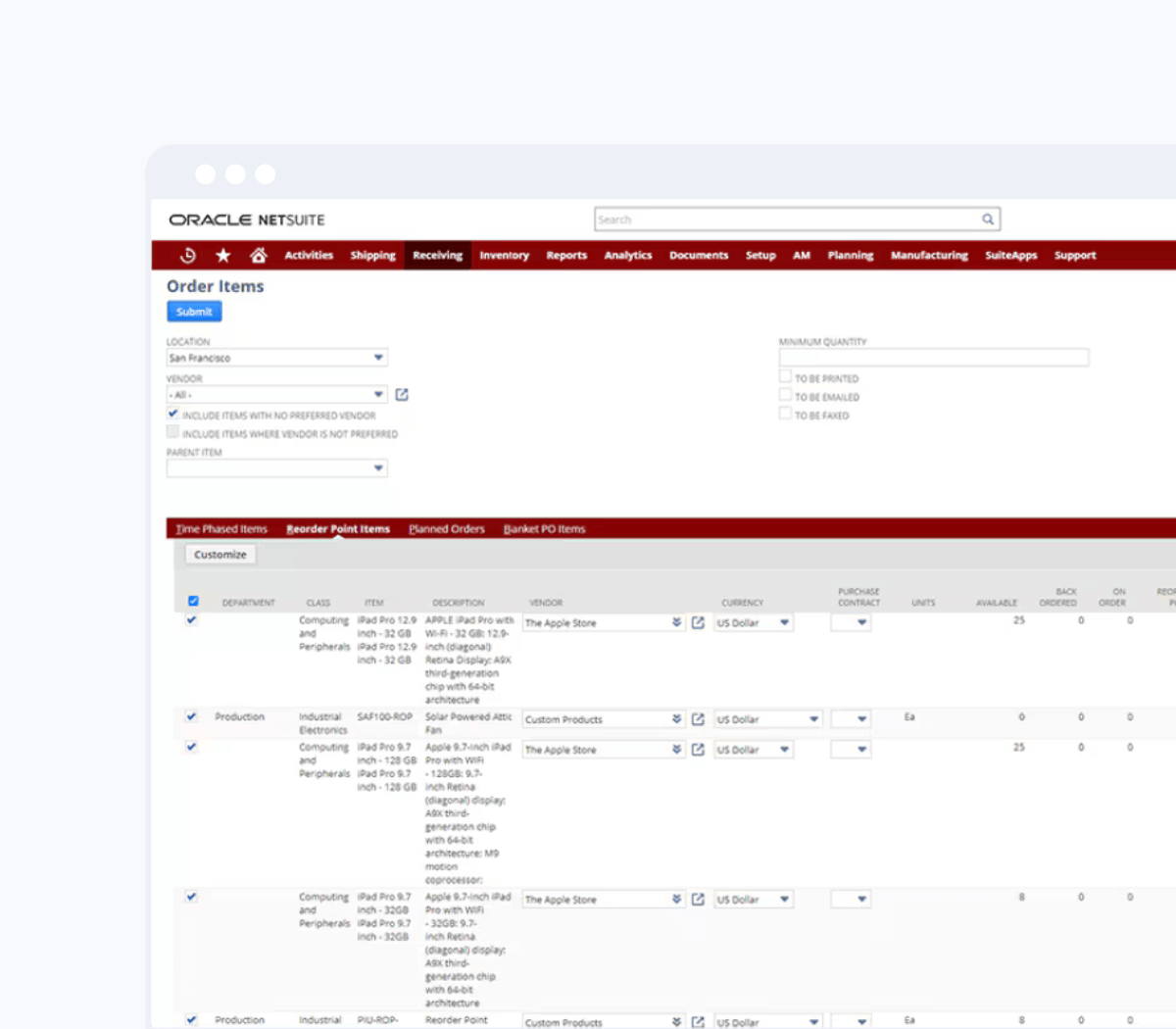
NetSuite Demand Planning gives you complete visibility and control over your entire forecasting and replenishment process, from historical sales analysis and demand forecasting through to automated purchase order recommendations and inventory optimisation. This comprehensive solution eliminates the guesswork of manual planning by connecting your demand data directly to your inventory and financials within one powerful, cloud-based ERP system.
-
Get a NetSuite pricing estimate
Let Annexa, Australia and New Zealand’s most experienced NetSuite implementation partners, prepare a tailored pricing estimate for your organisation.
Core features of Netsuite demand planning
Increase accuracy and efficiency
-
Lower costs
Efficiently manage cash flow by minimising carrying costs and the amount of cash tied up in inventory.
-
Adopt leaner strategies
Reduce wastage of warehouse space and lower inventory costs by ensuring there is enough stock to produce only what you need, when you need it.
-
Drive profitability & ROI
Ensure there is always stock in hand to fill customer orders — without excess that will go unsold or need to be discounted.

Who is NetSuite Demand Planning for?
NetSuite Demand Planning is suited to product-based businesses carrying meaningful inventory where purchasing decisions are currently driven by manual processes, fixed parameters, or individual buyer judgement rather than systematic analysis of demand data.
-
Wholesale and distribution businesses managing large SKU counts.
-
Retail businesses with seasonal demand patterns.
-
Manufacturers relying on purchased components and raw materials.
-
Importers with long ocean freight lead times.
-
E-commerce businesses managing inventory across multiple fulfilment locations or channels.
-
Businesses that have recently experienced costly stockout or overstock situations.






Why choose Annexa?
At Annexa, we combine deep Oracle NetSuite ERP expertise with a practical, people-first approach. We work alongside your team to deliver implementations that are built to last and designed to evolve as your business grows.
- Over a decade as a leading Oracle NetSuite Solution Provider across Australia and New Zealand
- Proven delivery across complex ERP implementations, integrations and multi-entity environments
- A structured implementation methodology shaped by real-world customer outcomes
- One of the most highly certified NetSuite teams in the region, spanning finance, technical and integration specialists
- Ongoing optimisation and advisory services to help customers keep extracting value from NetSuite
Collaboration sits at the centre of how we work. We build long-term partnerships with our customers, acting as an extension of their team to support growth, change and continuous improvement.



Related micro vertical (if any)
RESOURCES
Customer stories
let’s chat
Progress starts with engaging conversations.
Reach us via the online chat, the form, or give us a call.
- ✓ NetSuite AI & ecosystem experts
- ✓ Leaders in integration
- ✓ Award-winning team
- ✓ Strategic partner network
- ✓ Innovation always
Frequently asked questions
NetSuite Demand Planning is a feature within the NetSuite ERP system that enables businesses to forecast demand for their products or services accurately.
It uses historical sales data, trends, and other relevant factors to predict future demand for goods or services. It helps businesses anticipate customer needs and optimise inventory levels accordingly.
Some benefits include improved inventory management, reduced stockouts and excess inventory, increased customer satisfaction, and better decision-making based on data-driven forecasts.
Generally, at least 12 months of sales history is recommended to produce reliable forecasts, particularly for items with seasonal patterns where a full annual cycle is needed to identify the demand shape. Items with less history can still be forecast using simpler methods, but the accuracy will improve as more history accumulates. For businesses migrating to NetSuite, historical sales data can be imported as part of the implementation to provide an immediate forecast foundation.
For new products without sales history, NetSuite supports manual forecast entry or the ability to use a similar product’s history as a proxy. New product forecasting is inherently less accurate than history-based forecasting, and Annexa advises on the appropriate approach for new SKU planning during implementation.
NetSuite is used by businesses of all sizes, from startups to rapidly growing companies. If you are considering making the switch but unsure about the cost, here is a quick breakdown. NetSuite operates on an annual subscription model, which includes three key components: the core platform, optional modules, and the number of users. There is also a one-time implementation fee for the initial setup. As your business expands, you can easily add new modules and users, thanks to the flexibility of cloud software. Demand Planning is available as an add-on module. Want to get a NetSuite pricing estimate? Contact us now to discuss your specific needs.
Yes. Supplier lead times are configured against each vendor or item-vendor combination in NetSuite and are factored into replenishment recommendations to ensure purchase orders are generated with sufficient lead time to receive stock before the forecast demand date.
Yes. Demand forecasts and replenishment recommendations are presented for review before any purchase orders are created. Planners can adjust forecast quantities, modify recommended order amounts, or exclude specific items from a planning run before converting recommendations to purchase orders.
For manufacturing businesses, NetSuite Demand Planning can feed into the Material Requirements Planning process, using the finished goods demand forecast to drive component and raw material purchase recommendations. This connection ensures that procurement of purchased inputs is aligned with the production plan rather than being managed independently.
Yes. NetSuite Demand Planning supports multi-location planning, generating replenishment recommendations for each stocking location based on location-specific demand history and inventory positions. This is important for businesses with distributed inventory across multiple warehouses or distribution centres.