

Last Updated on 21 September 2026
If you’ve been in a room where the month-end close takes three weeks, where budget season means emailing spreadsheets back and forth for a month or where consolidating results across entities requires a separate offline process – you already understand the problem NetSuite Enterprise Performance Management (EPM) is built to solve.
EPM is a suite of connected financial performance tools that sits on top of NetSuite’s core ERP. It brings planning, budgeting, forecasting, account reconciliation, financial close and reporting into a single coordinated environment, giving finance teams the capacity to focus on analysis and decisions. Three of the six EPM modules are currently available to ANZ customers, with the remainder expected to follow.
In this article, we cover what NetSuite EPM is, what’s included, who it’s designed for and how it differs from NetSuite’s core financial management.
TL;DR
- What it is: NetSuite EPM is a separately licensed suite of tools that extends NetSuite’s core financial management capabilities across planning, budgeting, forecasting, reconciliation, close management and reporting.
- Who it’s for: Finance teams that have outgrown spreadsheet-driven planning and close processes – typically mid-market and enterprise organisations managing multiple entities, complex reporting requirements or extended close cycles.
- What’s new: The 2026.1 release added AI agents across Account Reconciliation, Planning and Budgeting and Profitability and Cost Management, making EPM considerably more capable than it was twelve months ago.
Get a personalised NetSuite pricing estimate
Receive a tailored NetSuite quote based on your business requirements, users, modules and implementation needs.
What does EPM stand for?
EPM stands for Enterprise Performance Management. The term describes the processes and tools organisations use to monitor, measure and manage business performance against financial and operational goals. In the context of NetSuite, EPM refers specifically to a suite of applications built on Oracle Fusion Cloud EPM that integrates directly with NetSuite’s core ERP data.
That integration is the key distinction. Because NetSuite EPM connects natively to your live NetSuite environment, planning and reporting always draw from the same source of truth as your operational and financial records. Data flows automatically across the platform, exports, manual transfers and version reconciliation between systems are taken out of the equation entirely.
What’s included in NetSuite EPM?
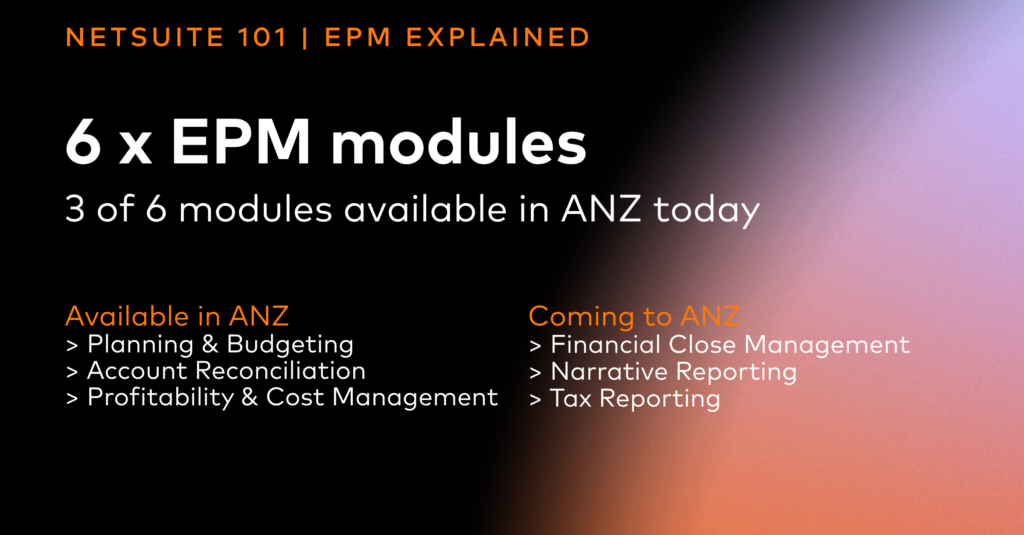
NetSuite EPM covers six functional areas globally. Three are currently available to ANZ customers, with the remaining modules expected to follow. The three available now are marked below.
NetSuite Planning and Budgeting – available in ANZ. A dedicated planning environment for company-wide and departmental budgets, forecasts and scenario models. It supports driver-based planning, workforce planning, demand forecasting and what-if analysis, with embedded AI and ML that identifies trends, refines forecasts and generates narrative commentary explaining why numbers have moved. Approval workflows and audit trails are built in, bringing version control and governance directly into the planning process.
NetSuite Account Reconciliation – available in ANZ. Automates the reconciliation process across bank accounts, credit cards, intercompany transactions and subledger accounts. A high-volume auto-match engine handles the bulk of transaction matching, with intelligent suggestions for items that fall outside predefined rules. Flexible matching configurations support one-to-one, many-to-one and many-to-many patterns. Every reconciliation is stored in a secure document repository with full audit and compliance logging.
NetSuite Profitability and Cost Management – available in ANZ. Allocates costs and analyses profitability at a granular level – by product, customer, region, channel or any other dimension relevant to the business. The 2026.1 release added an AI agent to this module, surfacing cost drivers and margin movements for finance teams to act on directly.
NetSuite Financial Close Management – coming to ANZ. Coordinates and tracks the close process across entities and teams from a single dashboard. Finance controllers can see the status of every close task, identify blockers and manage dependencies with full visibility across the team. The 2026.1 release added AI-powered monitoring that surfaces trends and exceptions during close, with direct links to the tasks requiring attention.
NetSuite Narrative Reporting – coming to ANZ. Combines financial statements and narrative commentary in a single report, with full support for multi-entity consolidation, currency adjustments, intercompany eliminations and tax alignment. Reports are built once and refreshed automatically from live NetSuite data, so the manual rebuild that typically precedes board and investor reporting becomes part of the platform’s regular cycle.
NetSuite Tax Reporting – coming to ANZ. Aligns tax reporting with corporate financial reporting, supporting jurisdiction-specific requirements within the same platform as the rest of the finance function.
Who is NetSuite EPM designed for?
EPM is best suited to finance teams where the current planning and close process has hit practical limits. The signals tend to be consistent: budget season requires significant coordination effort across spreadsheets and email threads, the month-end close runs longer than the business needs it to, consolidating results across entities requires offline work that sits outside the ERP and financial reports require manual assembly before distribution.
In terms of organisation type, EPM is most relevant to mid-market and enterprise businesses running multiple entities, operating across currencies or managing reporting obligations that require a governed, auditable process. It’s also well suited to fast-growing businesses where planning complexity is increasing faster than the current spreadsheet infrastructure can absorb.
NetSuite EPM is a separately licensed product. It is not included in a standard NetSuite subscription, so if EPM capabilities are relevant to your planning and close requirements, that’s a conversation to have with your Annexa account manager before assuming it’s already available in your environment.
How does NetSuite EPM differ from NetSuite’s core financial management?
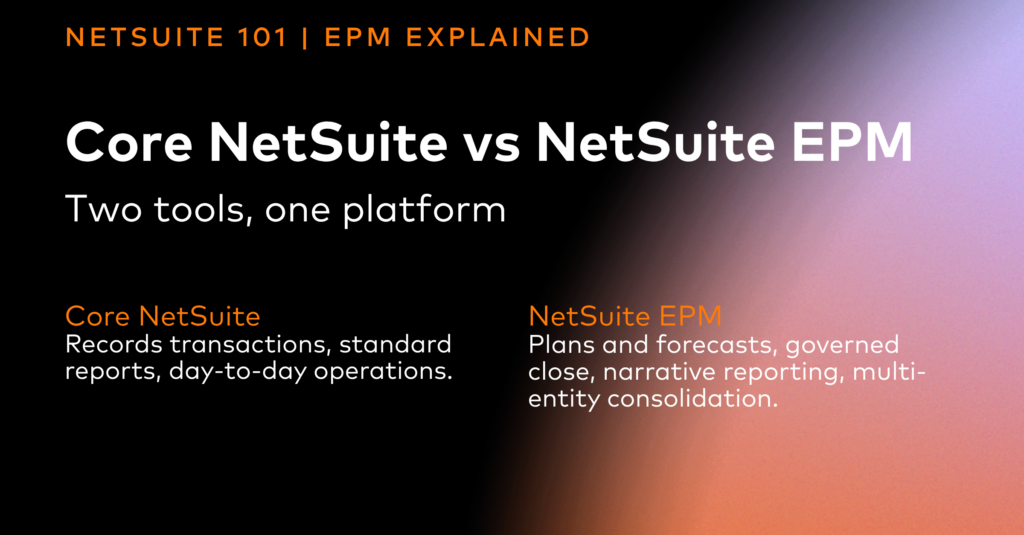
NetSuite’s core financial management covers the day-to-day back-office functions: general ledger, accounts receivable, accounts payable, fixed assets and basic financial reporting. These are transactional and operational tools, they record what has happened and produce standard reports from that data.
EPM operates at a different level. It takes that transactional data as its input and applies planning, analysis and governance logic on top of it. Budgeting and forecasting, scenario modelling, account reconciliation at scale, coordinated close management and narrative financial reporting are capabilities that live in EPM, on top of the foundation core NetSuite provides.
A useful way to think about it: core NetSuite tells you what happened. EPM helps you plan what should happen, measure performance against that plan and close and report on the result in a governed, auditable way.
Kieser – a case study for NetSuite EPM
Kieser. Kieser is a clinical strength training and physiotherapy organisation operating more than 30 clinics across Australia. As the business expanded from 13 to 31 clinics, the finance team was managing operations across 27 separate accounting files and approximately 80 Excel spreadsheets. Annexa implemented NetSuite ERP alongside Planning and Budgeting and Account Reconciliation. The budgeting cycle reduced from six months to around two months. Month-end close came down from 20-25 days to three to five days, with year-end completed on day three. Intercompany invoicing across 31 entities was automated, removing around 2,000 manual transactions each month. Kieser’s finance team moved from data entry and reconciliation work to variance analysis and forward-looking support for clinic leaders.
You can dive deeper into Kieser’s story here:
- Blog: Kieser shares finance transformation story at CFO Symposium Melbourne
- Blog: A deeper look at finance transformation with NetSuite and NSPB – Kieser’s perspective
- Webinar replay: Outgrowing Xero: How Kieser set the stage for growth with NetSuite
What changed with EPM in 2026
The 2026.1 release moved EPM’s AI capabilities from a roadmap item to a working reality across three modules. In Account Reconciliation, a new AI assistant automates setup for newly created accounts – assigning preparers, applying formats and learning from prior cycles – while a machine learning-powered transaction matching assistant supplements existing rule-based engines with pattern recognition that improves over time. In Planning and Budgeting, AI and ML continuously analyse data trends and generate commentary that explains why numbers have changed. In Profitability and Cost Management, an AI agent surfaces cost drivers and margin movements for direct review.
For finance teams already on NetSuite EPM, the 2026.1 release is a reason to review which of these capabilities are active in your environment. For those evaluating EPM, the AI additions make the platform considerably stronger than it was twelve months ago.
How Annexa can help
Annexa works with ANZ businesses to assess whether EPM is the right fit for their current environment, scope the implementation and ensure the platform is configured to reflect how the business actually plans, closes and reports. If EPM has come up in your planning conversations and you want to understand what it would involve for your organisation, get in touch with the team.
To understand what NetSuite would cost for your organisation, visit our NetSuite pricing page.
Frequently asked questions
Is NetSuite an ERP or EPM?
NetSuite is an ERP – a cloud-based platform that manages the day-to-day operational and financial functions of a business. EPM is a separate suite of tools that sits on top of NetSuite and extends it into planning, forecasting, reconciliation and financial close. The two are complementary: ERP handles what is happening in the business, EPM helps finance teams plan, analyse and report on performance.
Is NetSuite EPM the same as Oracle EPM?
NetSuite EPM is built on Oracle Fusion Cloud EPM technology and is designed specifically for mid-market businesses running NetSuite as their ERP. Oracle EPM Cloud is a separate, more extensive offering typically suited to larger enterprise environments running Oracle EBS or SAP. If you are on NetSuite, NetSuite EPM is the relevant product.
Does NetSuite EPM replace spreadsheets?
That’s the intent. NetSuite EPM centralises planning, budgeting, forecasting and reconciliation inside a governed platform connected directly to your NetSuite data. The manual spreadsheet processes that sit outside the ERP – collecting budget inputs, reconciling entity results, assembling management reports – are the specific workflows EPM is designed to bring in-house.
How long does it take to close the books with NetSuite EPM?
Results vary by organisation. EPM customers consistently report material reductions in close time. One of Annexa’s customers, Kieser, reduced year-end close from 25 days to 3 days following their NetSuite implementation. EPM’s close management, reconciliation automation and intercompany consolidation tools are the primary drivers of that kind of improvement.
What is the difference between EPM and FP&A?
FP&A (Financial Planning and Analysis) is a finance function – the team and processes responsible for budgeting, forecasting, scenario planning and management reporting. EPM is the technology that supports that function. NetSuite EPM gives FP&A teams the platform to do their work inside a governed, integrated environment connected directly to live ERP data.
Do I need EPM if I already have NetSuite?
It depends on where your current process sits. If planning and close are running well inside core NetSuite – or if your organisation is at an earlier stage of growth – EPM may be a future consideration. If your team is managing budget consolidation manually, running extended close cycles or producing reports outside the ERP, EPM is worth evaluating. Speak with your Annexa account manager to assess whether the capabilities map to your current requirements.
Is NetSuite EPM included in a standard NetSuite subscription?
No. NetSuite EPM is a separately licensed add-on. It requires a separate commercial conversation. Contact the Annexa team to understand what EPM would cost for your organisation and whether the licensing structure fits your requirements.
Get a personalised NetSuite pricing estimate
Receive a tailored NetSuite quote based on your business requirements, users, modules and implementation needs.
Annexa is a leading NetSuite partner with extensive experience designing and implementing tailored business systems, including payroll solutions, financial management, warehouse management and ecommerce solutions.