
Last Updated on 24 June 2026
Most businesses reach a point where the systems holding them together start holding them back. Finance is running on one platform, inventory on another, and the data that should connect them lives in spreadsheets that someone updates manually on a Friday afternoon – and that is exactly what an ERP system is designed to solve.
Enterprise Resource Planning (ERP) is a category of software that connects an organisation’s core business functions – finance, operations, supply chain, sales, HR and more – into a single integrated system. Rather than maintaining separate tools that each hold their own version of the truth, an ERP gives every part of the business access to the same data in real time.
For Australian and New Zealand businesses navigating growth, compliance complexity and an increasingly competitive operating environment, the question of whether and when to implement ERP is as strategic as any decision a leadership team will make.
The core idea behind ERP
The concept of an ERP system is straightforward even if the implementation rarely is. An ERP system sits at the centre of a business and acts as its operating backbone. When a sale is made, the inventory updates. When inventory is updated, procurement is informed. When an invoice is raised, the accounts receivable ledger reflects it. There’s no manual re-entry or need for reconciliation between systems and no version of events that depends on which spreadsheet you are looking at.
This single source of truth is what distinguishes ERP from a collection of best-of-breed tools. Individual platforms like a standalone CRM, an accounting package or a warehouse management system can each be excellent at what they do. The challenge is that they were not designed to talk to each other. Every integration between them is a potential point of failure, a manual process or a reporting gap.
An ERP replaces that fragmentation with a unified data model. Every transaction, every record, every workflow draws from and contributes to the same underlying dataset.
What does an ERP system actually include?
Modern ERP systems are modular, meaning businesses can implement the functions they need and expand over time. The core modules found in most enterprise ERP platforms include the following.
Financial management
The financial module is the foundation of any ERP system. It covers the general ledger, accounts payable and receivable, bank reconciliation, fixed assets, multi-currency transactions and financial reporting. For ANZ businesses operating across Australia and New Zealand – or internationally – this includes the ability to manage multiple entities, tax jurisdictions and currencies from a single chart of accounts.
Order and inventory management
Order and inventory management in ERP systems track stock levels, purchase orders, sales orders and fulfilment in real time. For distributors, retailers and manufacturers, this is where significant operational efficiency is gained. Reorder points can be automated, demand forecasting can draw on historical sales data, and warehouse teams work from the same inventory picture as finance and sales.
Supply chain management
Supply chain modules in cloud ERP platforms extend beyond inventory to cover supplier relationships, procurement workflows, landed cost tracking and logistics. For ANZ businesses with offshore sourcing – particularly common in retail, manufacturing and wholesale distribution – this visibility across the full supply chain is a meaningful operational improvement over disconnected purchasing and finance systems.
CRM and sales
Most ERP systems include CRM functionality that connects customer interactions, quotes, orders and payment history in one place. Rather than managing a separate CRM that holds no financial context, sales teams can see what a customer has ordered, what they owe and how they typically pay – all within the same system.
Manufacturing and production
For businesses that make things, ERP systems manage bills of materials, production scheduling, work orders and quality control. The connection between production and finance means material costs, labour and overhead flow automatically into product costing rather than being calculated separately.
Human resources and payroll
HR modules cover employee records, time and attendance, leave management, performance tracking and, in many platforms, payroll processing. In Australia and New Zealand, where payroll compliance requirements – including Single Touch Payroll, the Holidays Act in New Zealand and award interpretation – are particularly complex, having HR and payroll connected to the broader financial system reduces compliance risk.
Reporting and business intelligence
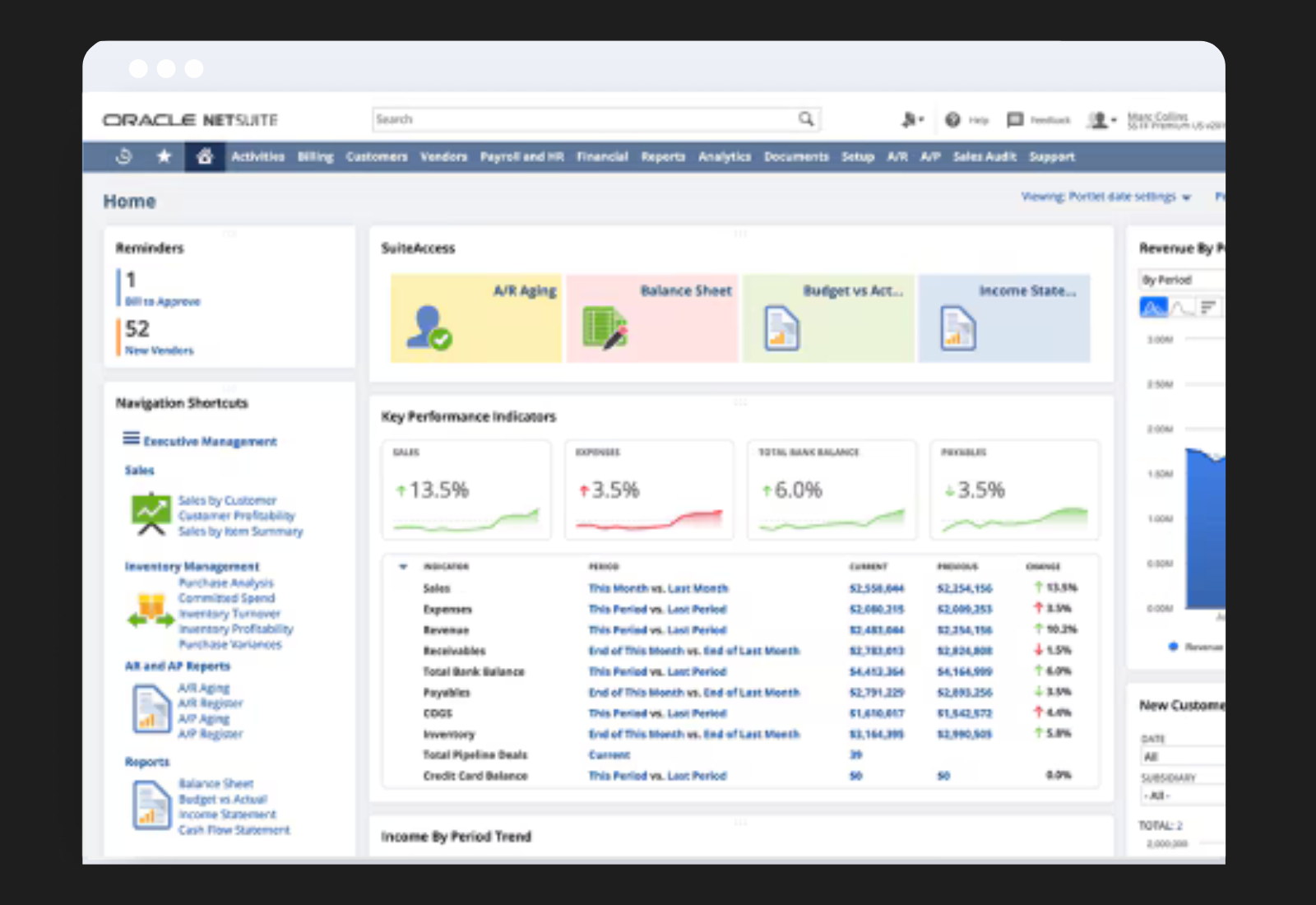
ERP systems generate real-time reports across all functions. Rather than waiting for month-end to understand where the business stands, finance leaders can access live dashboards covering cash flow, revenue by segment, gross margin by product line and outstanding receivables at any point.
Get a personalised NetSuite pricing estimate
Receive a tailored NetSuite quote based on your business requirements, users, modules and implementation needs.
Cloud ERP vs on-premise ERP
For most of ERP’s history, implementations meant installing software on servers that the business owned and maintained. That model – on-premise ERP – still exists and remains the right choice for some organisations, particularly those in heavily regulated industries or with complex legacy infrastructure requirements.
The shift in the past decade has been toward cloud ERP – software hosted and maintained by the vendor, accessed through a browser, and updated automatically on a regular release cycle. For ANZ mid-market businesses, cloud ERP has become the default choice for several reasons.
The upfront cost profile is different. Cloud ERP operates on a subscription model, spreading cost over time rather than requiring significant capital investment in hardware and licences. Implementation costs still apply, but the total cost of ownership over five years is typically lower than an on-premise equivalent.
Maintenance and updates no longer fall to the internal IT team either. Vendors manage infrastructure, security and upgrades. This is significant for businesses that lack dedicated IT resources or want to avoid the disruption of periodic major upgrades.
Access from anywhere also now matters more than it did. Post-pandemic working patterns have made browser-based access to core business systems a practical requirement and expectation of employees. Cloud ERP supports remote and distributed teams without VPN dependencies or remote desktop workarounds.
For ANZ businesses specifically, cloud ERP also provides a cleaner path to international expansion. Adding a new entity in Singapore or the United Kingdom does not require additional server infrastructure – it requires configuration within the existing platform.
How ERP systems have changed throughout the 2020s
ERP systems in 2026 look materially different from what they were five years ago. In particular, AI has moved from a feature listed in sales collateral to a functional part of how modern ERP systems operate.
The most significant change is in how users interact with data. Natural language interfaces – where a finance leader types a question in plain English and receives a direct answer drawn from live system data – are becoming standard in leading cloud ERP platforms. The saved search, the exported spreadsheet, the administrator-built report – these workflows are starting to give way to something more direct.
Agentic AI – software that can take action rather than just surface information – is beginning to appear in enterprise ERP. Use cases include automated bank transaction matching that learns from historical patterns, financial close agents that identify reconciliation discrepancies and propose adjusting entries, and planning tools that flag forecast variances and suggest corrections.
For ANZ businesses evaluating ERP in 2026, the gap between platforms that have genuinely embedded AI into core workflows and those that have added it as a layer on top is significant and will widen over the next few years.
Who uses ERP systems and when does a business need it?
The mid-market – businesses turning over $10 million to several hundred million dollars annually – is where the demand for ERP is strongest in Australia and New Zealand, and where the operational payoff is often most immediate.
The signals that a business is ready for ERP tend to be consistent regardless of industry. Finance teams spending significant time reconciling data between systems. Sales and operations working from different versions of inventory availability. Month-end close taking longer than it should because numbers need to be pulled from multiple sources and reconciled manually. Reporting that depends on one person who knows how to build the spreadsheet. Compliance obligations – tax, payroll, audit – that are increasingly difficult to manage without a system of record.
These are signs of a business that has grown beyond the systems it started with. For most ANZ businesses, that means outgrowing Xero or MYOB Acumatica – solid tools for early-stage finance management that were not designed to handle inventory, multi-entity reporting or operational complexity at scale. Others arrive at this point running QuickBooks, Microsoft Dynamics 365 or a combination of Odoo modules that have accumulated more integrations than anyone intended. The common thread is the same: the systems made sense when the business was smaller, and the cost of maintaining them has quietly overtaken the cost of replacing them. ERP is the logical next step.
What does ERP system implementation involve?
Implementing an ERP system is a significant undertaking. The businesses that get the most from it treat it as a business transformation project rather than a software installation.
A typical ERP implementation involves requirements gathering and scoping, data migration from existing systems, configuration of the platform to the business’s specific processes, integration with third-party systems that will remain in the stack, user training, and a period of parallel running before go-live.
Implementation timelines for mid-market businesses typically range from three to nine months depending on complexity, the number of entities involved and how much customisation is required. Working with an experienced implementation partner – one that knows both the platform and the industries they serve – compresses that timeline and reduces the risk of common failure points.
In Australia and New Zealand, local implementation expertise matters beyond just knowing the software. GST, BAS reporting, Single Touch Payroll, the Holidays Act, multi-currency for trans-Tasman operations and the specific compliance requirements of regulated industries all require configuration that a global implementation template will not address by default.
Read an in-depth guide > NetSuite implementation success guide for growing Australian and New Zealand businesses
ERP systems and the single source of truth
The phrase gets used a lot in ERP conversations, often loosely. So it is worth being precise about what it means in practice.
A single source of truth does not mean all data lives in one place forever. It means that when any part of the business needs to know the current state of something – inventory on hand, outstanding receivables, budget versus actual, headcount by department – there is one system that holds the authoritative answer.
For finance leaders, this changes the nature of reporting. The question “what are our numbers right now” stops being a data collection exercise and becomes a matter of looking at the system. For operations leaders, it means decisions about purchasing, staffing and fulfilment are based on current data rather than a best estimate.
For the business as a whole, it reduces the invisible cost of data reconciliation – the time spent by capable people checking figures against each other, resolving discrepancies and producing reports that are out of date by the time they are read.
Choosing the right ERP system
There is no universal answer. The right ERP for a fast-growing SaaS business in Sydney looks different from the right ERP for a multi-site manufacturer in Auckland or a wholesale distributor managing cross-border trade between Australia and Southeast Asia.
The factors that matter most in the selection process include how well the platform maps to your industry’s specific processes, the total cost of ownership over five years rather than just the headline licence fee, the implementation partner’s track record with businesses of your size and type, the vendor’s release cadence and investment in product development, and how the platform handles the regulatory and compliance requirements specific to Australia and New Zealand.
NetSuite, built on Oracle’s cloud infrastructure, is the most widely deployed cloud ERP globally and the platform Annexa specialises in. It covers the full range of functions described in this article, is continuously updated twice yearly, and has been adopted across the full range of ANZ mid-market industries – from retail and distribution through to professional services, manufacturing and technology businesses.
Read more > The complete guide to selecting a NetSuite implementation partner
FAQs
What does ERP stand for?
Enterprise Resource Planning. The name reflects the original concept: planning and managing the resources of an enterprise – people, materials, finances, equipment – through an integrated system.
Is ERP only for large businesses?
No. The mid-market is now the core market for cloud ERP. Businesses from around $10 million in annual revenue upwards regularly implement ERP systems, and cloud platforms have made the cost of entry significantly lower than it was a decade ago.
How long does ERP implementation take?
For mid-market businesses, typically three to nine months. Complexity, data quality, the number of entities and the degree of customisation required all affect the timeline.
What is the difference between ERP and accounting software?
Accounting software manages financial transactions. ERP connects financial management to operations, supply chain, sales, HR and more – giving finance a real-time view of the whole business rather than just the ledger.
How much does an ERP system cost?
Cloud ERP is priced on a subscription model, typically based on the number of users and modules required. Total cost includes the licence, implementation, data migration and ongoing support. For mid-market businesses, total first-year cost typically ranges from $50,000 to several hundred thousand dollars depending on scope and complexity.
What should we do before implementing an ERP?
Clean your data, map your current processes honestly (including the workarounds), define what success looks like before you start, and choose an implementation partner with specific experience in your industry and region. Speak to Annexa to understand what a NetSuite implementation would look like for your business.
Ready to take the next step in your NetSuite journey?
Whether you’re looking for more information, seeking expert consultation, or eager to get your NetSuite implementation underway, we’re here to help. Contact us to discuss your needs and how we can tailor NetSuite to your unique business requirements.
Read more: