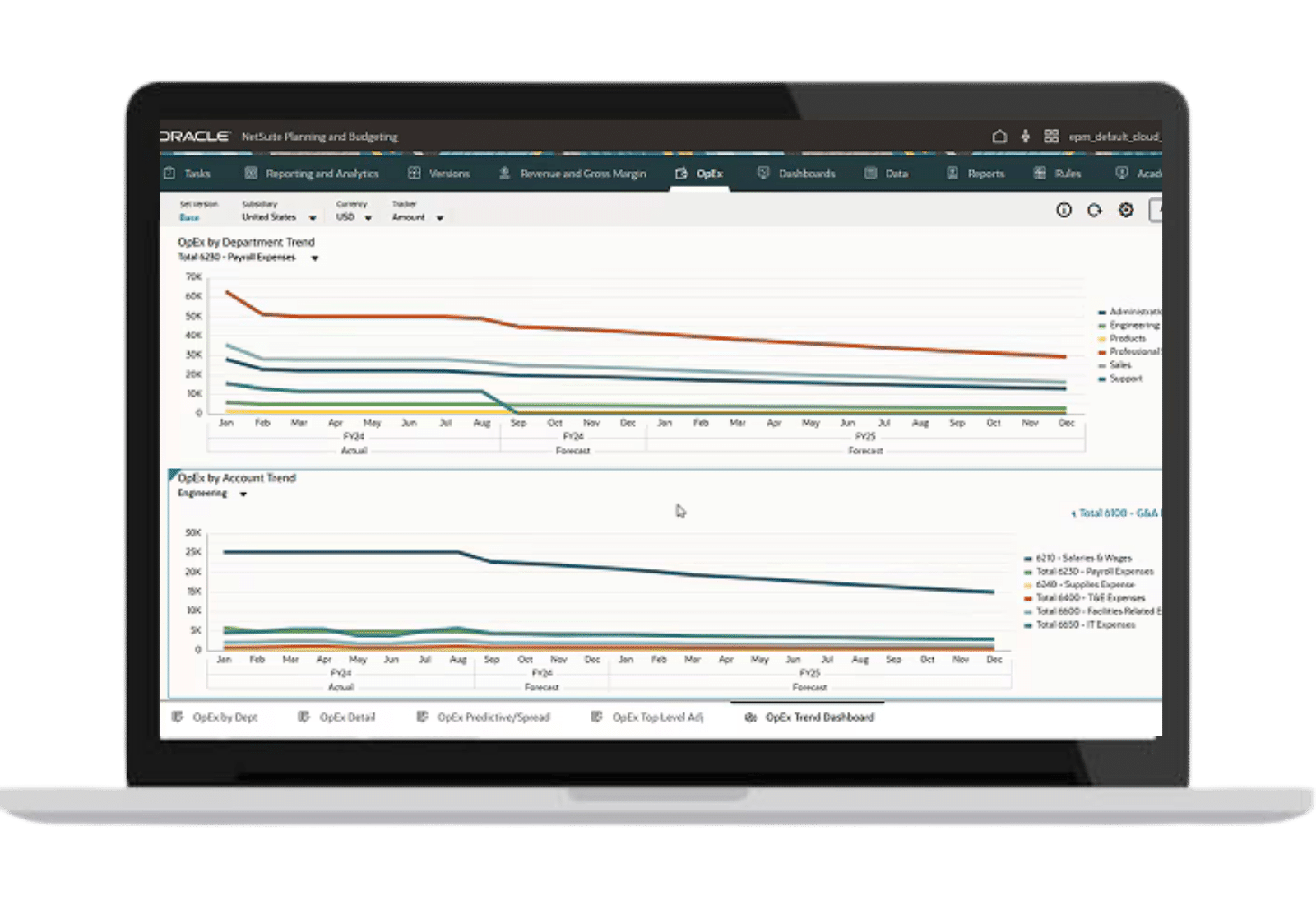

NetSuite Planning and Budgeting is an add-on module within NetSuite EPM that automates the recurring planning, budgeting and forecasting processes that most finance teams manage outside the ERP. Its purpose is to bring those processes inside a single environment where planning draws from live financial data, approval workflows are enforced and every version is tracked and auditable.
The distinction from standard NetSuite reporting is in the workflow. NetSuite’s core financial management records what has happened – a transaction enters the ledger, reports summarise the result. Planning and Budgeting asks what should happen by setting targets, building forecasts and modelling scenarios inside a single system where the collaborative work stays contained rather than scattered across spreadsheets and email.
Data flows from NetSuite’s chart of accounts and operational records into a planning environment where teams model budgets and forecasts. Once a forecast is built and approved, it sits within the same system as the actual results. When the month closes, actuals and forecasts can be compared directly without manual reconciliation or version management. The planning cycle becomes repeatable, governed and auditable.
TL;DR
- Planning and Budgeting brings budgeting and forecasting from spreadsheets into a governed, connected environment within NetSuite EPM
- Driver-based planning links expenses and revenue to operational factors, meaning forecasts update automatically when assumptions change
- Approval workflows, scenario modelling and audit trails replace the manual coordination and email cycles of traditional budget season
Where it sits in the NetSuite EPM suite
NetSuite EPM extends the core ERP with a set of dedicated performance management modules. Planning and Budgeting is the foundation that builds the plans and forecasts that other EPM modules, including Account Reconciliation and Narrative Reporting, draw from or operate alongside.
| EPM module | What it does |
|---|---|
| Planning and Budgeting | Company-wide and departmental budgets, forecasts, scenario models and driver-based planning with approval workflows |
| Account Reconciliation | Automated reconciliations and transaction matching to speed up and de-risk the close |
| Profitability and Cost Management | Granular allocation modelling and profitability analysis down to product or business line level |
| Narrative Reporting | Governed, collaborative report packages combining live data with written commentary |
Because Planning and Budgeting connects natively to NetSuite’s chart of accounts and operational data, the budgets and forecasts built in Planning and Budgeting share a data source with Account Reconciliation, Narrative Reporting and core NetSuite reporting. There is no version reconciliation between planning and close because there is only one source of truth across the platform. Planning and Budgeting is designed to stand alone, so you can deploy it without implementing Account Reconciliation, Narrative Reporting or any other EPM modules.
Kieser: a case study in planning transformation
Kieser is a clinical strength training and physiotherapy group operating more than 30 clinics across Australia. As the business expanded across the country, its finance team was managing operations across 27 separate accounting files and roughly 80 Excel spreadsheets. Budget season consumed six months of the year: Finance sent templates to department leaders, collected responses, consolidated results, identified discrepancies, sent feedback for revision and repeated the cycle. The interdependencies between entities meant budgets built in isolation often required major rework during consolidation.
Annexa implemented NetSuite ERP alongside Planning and Budgeting and Account Reconciliation. The impact was immediate.
- Budgeting cycle: 6 months → 2 months
- Month-end close: 20–25 days → 3–5 days (year-end: day 3)
- Intercompany invoicing: 2,000 manual transactions per month → automated
- Finance team focus: data entry and reconciliation → variance analysis and strategic support
Dive deeper into Kieser’s story:
- Blog: A deeper look at finance transformation with NetSuite and NSPB – Kieser’s perspective
- Case study: Kieser grows a healthier finance function with NetSuite and Annexa
- Webinar replay: Outgrowing Xero – How Kieser set the stage for growth with NetSuite
- NetSuite: Kieser takes control of reporting, budgeting, and forecasting with NetSuite EPM
- CRN: How Annexa rebuilt physiotherapy chain Kieser’s finance platform
How driver-based planning works
The distinction between a traditional spreadsheet budget and a driver-based forecast inside Planning and Budgeting sits in the starting point. A spreadsheet budget starts with last year’s numbers and applies a percentage increase. A driver-based forecast starts from operational factors that drive expenses and revenues – headcount determines payroll costs, sales volume drives revenue, trips determine travel spend.
Revenue planning multiplies sales units by average price to forecast total revenue. Expense planning connects travel costs to trips and nights per trip, headcount costs to employee numbers and compensation levels, marketing spend to departmental budgets or revenue percentages. Operational assumptions feed the model, financial outcomes flow automatically, and when an assumption shifts, forecasts recalculate without manual intervention.
When a department plans to hire five more people, the system recalculates payroll, benefits, headcount tax and office space automatically. A scenario model exploring revenue growth under two different pricing strategies can run upside and downside cases in parallel, letting the finance team and leadership compare outcomes directly instead of building separate spreadsheet versions and reconciling them manually.
Workforce planning in the broader cycle
Workforce planning inside Planning and Budgeting connects headcount strategy to financial planning by placing workforce headcount and costs within the same model as departmental budgets and revenue forecasts, so compensation budgets build in full context. When finance models a scenario involving sales team growth, the corresponding payroll increase appears in the forecast automatically.
Headcount and compensation planning covers forecast headcount by role or department, salary and bonus structures, benefits and related costs, and tax and statutory obligations. Pre-built templates and drivers automate much of the calculation once planning assumptions are set. HR and finance teams operate from the same forecast, so hiring plans stay aligned with departmental budgets and revenue targets throughout the planning cycle, not reconciled as a separate exercise at the end.
Approval workflows and scenario governance
Planning and Budgeting embeds the approval process directly into the planning cycle by having each contributor work on their assigned section within the system instead of collecting drafts by email and managing versions in a shared folder. Status tracking shows which sections are complete, in review or awaiting approval, and audit trails record who changed what and when, which becomes important when external auditors ask about the lineage behind a forecast.
Scenario modelling lets a finance team build multiple versions of the same plan in parallel. An upside scenario with growth assumptions, a base case forecast, and a downside scenario with conservative assumptions run within the same system. Leadership can compare the financial impact of different strategic choices directly instead of managing multiple spreadsheet versions.
Where AI fits in NetSuite Planning and Budgeting
Planning and Budgeting applies AI and machine learning to identify patterns in historical data and suggest improvements to forecasts. The system can analyse year-over-year trends, seasonality patterns and variance drivers to generate baseline forecasts automatically. When actuals arrive, AI commentary explains why numbers have moved against forecast, surfacing trends or exceptions that warrant investigation.
Planning and Budgeting’s AI is a forecasting assistant, not an automated process. Finance teams build assumptions and validate results themselves. The AI surfaces which forecasts are drifting and why, so investigation becomes the focus instead of hours spent manually comparing actuals against forecasts each month.
Who gains the most from NetSuite Planning and Budgeting
The strongest candidates for Planning and Budgeting share a profile – extended planning cycles that run through spreadsheets and email, departmental budgets consolidated manually, and forecasts that become stale quickly.
- Organisations where budget season takes six weeks or longer due to collection and consolidation cycles
- Finance teams managing multiple entities, departments or cost centres where consolidation happens outside the ERP
- Businesses with significant headcount or workforce planning requirements, where hiring is driven by departmental budgets and revenue targets
- Companies needing fast scenario analysis to evaluate strategic decisions, market downturns or growth opportunities
- Finance teams already running core NetSuite who want planning and forecasting connected to actual results
For a business with a simple finance structure, a stable business model and a short planning cycle running effectively in spreadsheets, Planning and Budgeting may not be needed. The value scales with the complexity of the planning process and how quickly the business needs to adapt to change.
Getting started in Australia and New Zealand
Planning and Budgeting is licensed as an add-on module and configured against your chart of accounts, departmental structure and planning dimensions. Implementation typically starts by mapping the annual budget cycle into the system, training the core planning team and running one full cycle in parallel with the existing spreadsheet process before moving over entirely. Many organisations run both in parallel for a year to validate the new process and make adjustments before finalising the cutover.
Annexa works with Australian and New Zealand finance teams across the full NetSuite EPM suite, from planning and budgeting through to close and reporting. If your budget season is running longer than it should or your planning lives outside the ERP, contact the Annexa team to discuss how Planning and Budgeting could reshape your cycle.
Get a personalised NetSuite pricing estimate
Receive a tailored NetSuite quote based on your business requirements, users, modules and implementation needs.
Frequently asked questions
What is NetSuite Planning and Budgeting?
NetSuite Planning and Budgeting is an add-on module within the NetSuite EPM suite that automates planning, budgeting and forecasting processes. It brings planning inside the ERP by providing a single environment where teams build driver-based forecasts, model scenarios, collaborate through approval workflows and maintain audit trails of all changes.
Is NetSuite Planning and Budgeting available in Australia?
Yes. Planning and Budgeting is available to Australian and New Zealand customers as a separately licensed add-on module to your NetSuite environment.
What is driver-based planning?
Driver-based planning links expenses and revenues to the operational factors that drive them, not to a percentage of last year’s numbers. For example, headcount costs are calculated from headcount and compensation levels, travel expenses from trips and nights per trip, and revenue from units sold and average price. When operational assumptions change, financial forecasts update automatically.
How does scenario modeling work?
Scenario modeling lets finance teams build multiple versions of the same plan in parallel within the system. You might model an upside scenario with growth assumptions, a base case forecast and a downside scenario with conservative assumptions. All scenarios run against the same planning model, so comparing financial outcomes and evaluating strategic options is straightforward.
Does Planning and Budgeting include workforce planning?
Yes. Workforce planning inside Planning and Budgeting connects headcount strategy to financial forecasts. Headcount and compensation planning sits within the same model as departmental budgets and revenue forecasts, so hiring plans stay aligned with departmental budgets and revenue targets rather than being built separately.
What role does AI play in Planning and Budgeting?
Planning and Budgeting applies AI and machine learning to identify trends in historical data and generate baseline forecasts automatically. When actual results arrive, AI commentary explains why variances have occurred, surfacing trends or exceptions for investigation. This is a forecasting assistant that accelerates manual work, not a fully automated process.
How does Planning and Budgeting differ from core NetSuite financial management?
Core NetSuite records what has happened: transactions enter the ledger and reports summarise results. Planning and Budgeting asks what should happen: it builds forecasts, models scenarios and manages the planning cycle with approval workflows and audit trails. Planning and Budgeting sits on top of core NetSuite and draws from the same data source, so actual results and forecasts stay in sync.
How much does NetSuite Planning and Budgeting cost?
Planning and Budgeting is a separately licensed module with pricing based on user count, storage and the specific edition (Standard or Premium). For a personalised NetSuite quote including Planning and Budgeting and any other EPM modules relevant to your requirements, contact the Annexa team.