
Last Updated on 15 April 2026
SuiteConnect 2026 has wrapped across Sydney and Melbourne, with a consistent set of themes emerging across both events. Annexa was proud to sponsor in both cities, with customer perspectives shared throughout, including insights from one of our customers – Matthew Nott, CFO at MAAP.
Here are the product highlights and key themes from SuiteConnect 2026.
Keynote focus – visibility and operational responsiveness
The starting point for much of the keynote was that predictability remains difficult to find, and organisations are no longer operating on the assumption that it will return. Instead, they are building operating models that can function in ongoing uncertainty, which changes the role of data from retrospective reporting to something that supports real-time judgement. Leaders need to understand both risk and opportunity while managing increasing complexity across supply chains, channels and geographies, all while continuing to grow without a corresponding increase in headcount and with sustained cost pressure.
These conditions are driving a different use of AI. The focus has moved beyond individual use cases like writing or summarising towards embedding intelligence inside operational systems, where it can influence decisions rather than just tasks. This is where the impact shifts from individual productivity to how the business actually runs. That only works if the underlying data is connected. As noted in the keynote, when data is fragmented, “AI doesn’t see a company, it sees fragments”.
AI capabilities shared at SuiteConnect 2026 Australia
Exception management and intelligent close
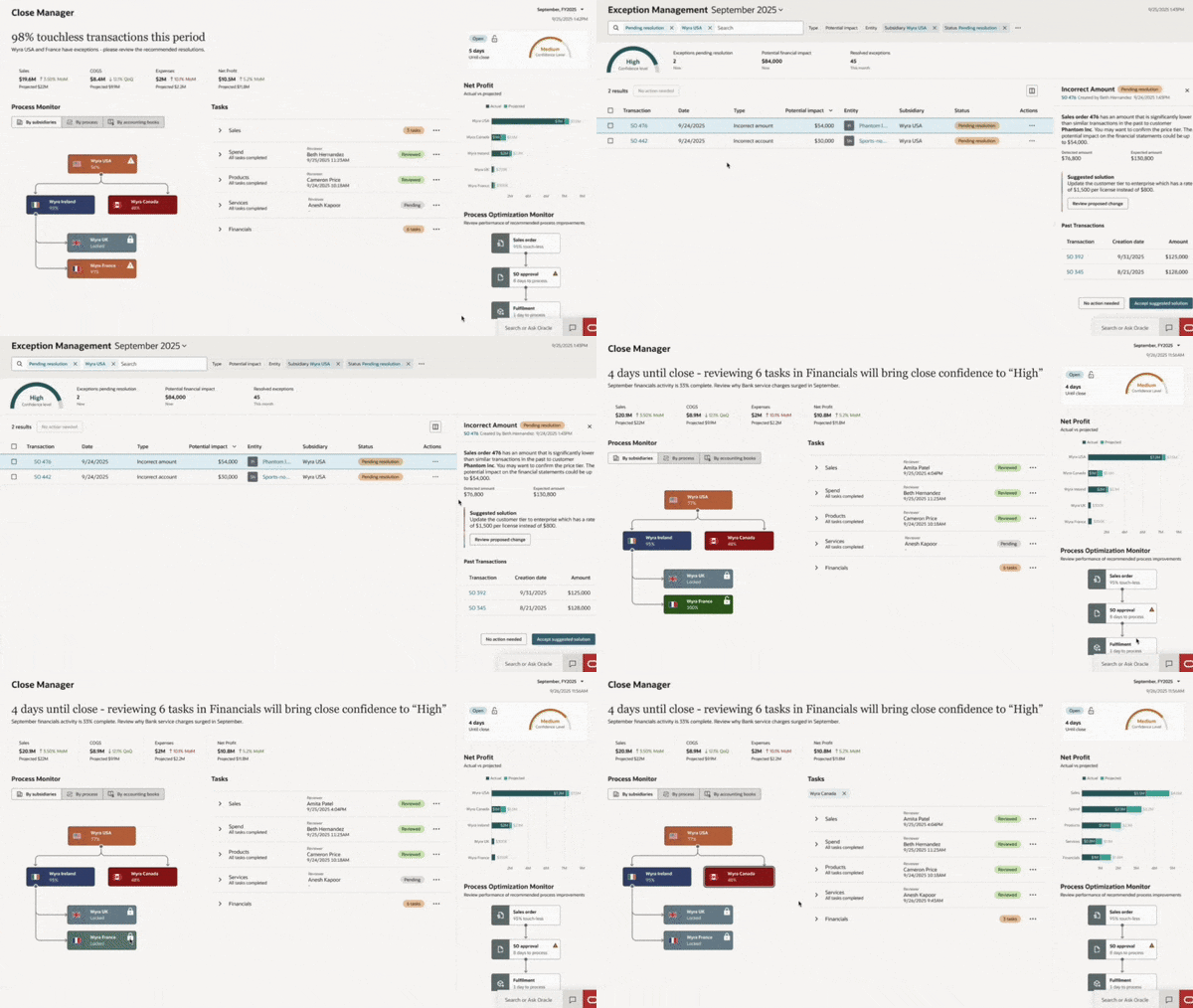
AI-driven exception management continuously scans financial data during the period, flags anomalies such as incorrect transactions and recommends corrective actions as they arise. This is paired with an intelligent close manager that gives a live view of close progress, including task status, net income impact and an overall confidence level towards completion.
Adoption outlook
Most ANZ finance teams are still identifying issues at month end, which creates rework, delays and pressure on already lean teams. Shifting this work into the period changes the dynamic. Issues are resolved earlier, the close becomes more predictable and reporting timelines shorten without increasing effort.
Ready to use now?
Yes. These capabilities are available now and represent one of the more immediate, practical improvements for finance teams.
AI-powered bank transaction matching
Generative AI is used to interpret bank transaction descriptions and match them to general ledger entries, including ambiguous or inconsistent references that traditional rules struggle with.
Adoption outlook
Bank reconciliation remains one of the more manual parts of finance, particularly for businesses operating across multiple entities or accounts. Improving match rates reduces time spent investigating transactions and removes a common bottleneck in the close process, while also improving accuracy in cash reporting.
Ready to use now?
Yes. This is available now in the 2026.1 release and delivers immediate efficiency gains in a process most teams already struggle with.
Ask Oracle (natural language interface)
Ask Oracle is a natural language assistant embedded across NetSuite that allows users to search, analyse and act on data using plain language, without needing to navigate reports or menus. Responses are context-aware, meaning a CFO and an operations user asking the same question will receive different, role-relevant insights.
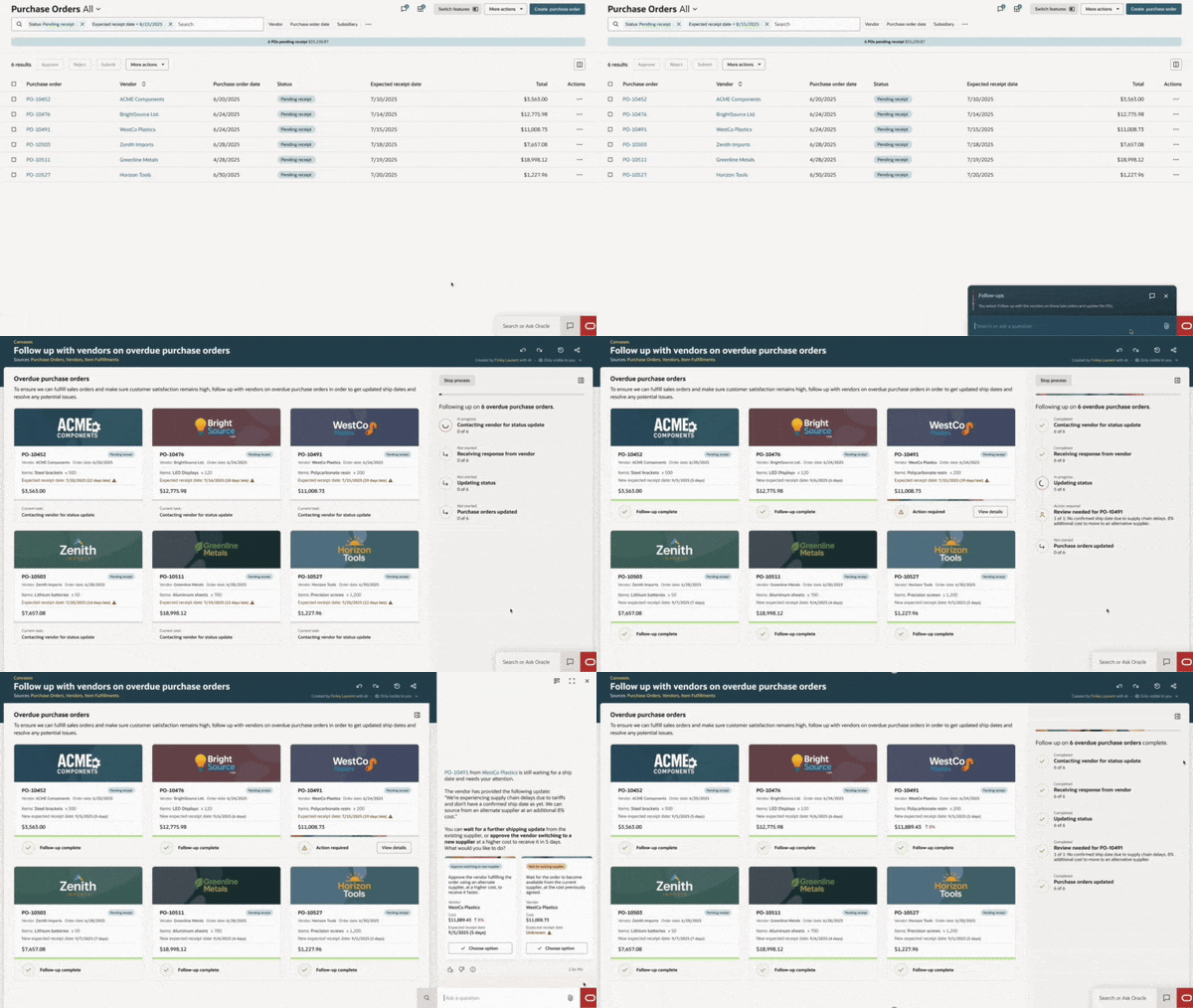
Core to the NetSuite Next user experience is Ask Oracle, a natural language assistant that enables users to search, navigate, analyze, and act across the entire NetSuite dataset using their own words.
Adoption outlook
In many ANZ organisations, access to data is still concentrated with a small number of people. A natural language interface reduces that dependency and shortens the path from question to answer, allowing leaders to interrogate data directly rather than waiting on reports or manual analysis.
Ready to use now?
Not yet. Ask Oracle sits within NetSuite Next, which is expected to roll out in ANZ over the next 12 months, with a preview in around six months.
AI-generated narrative insights
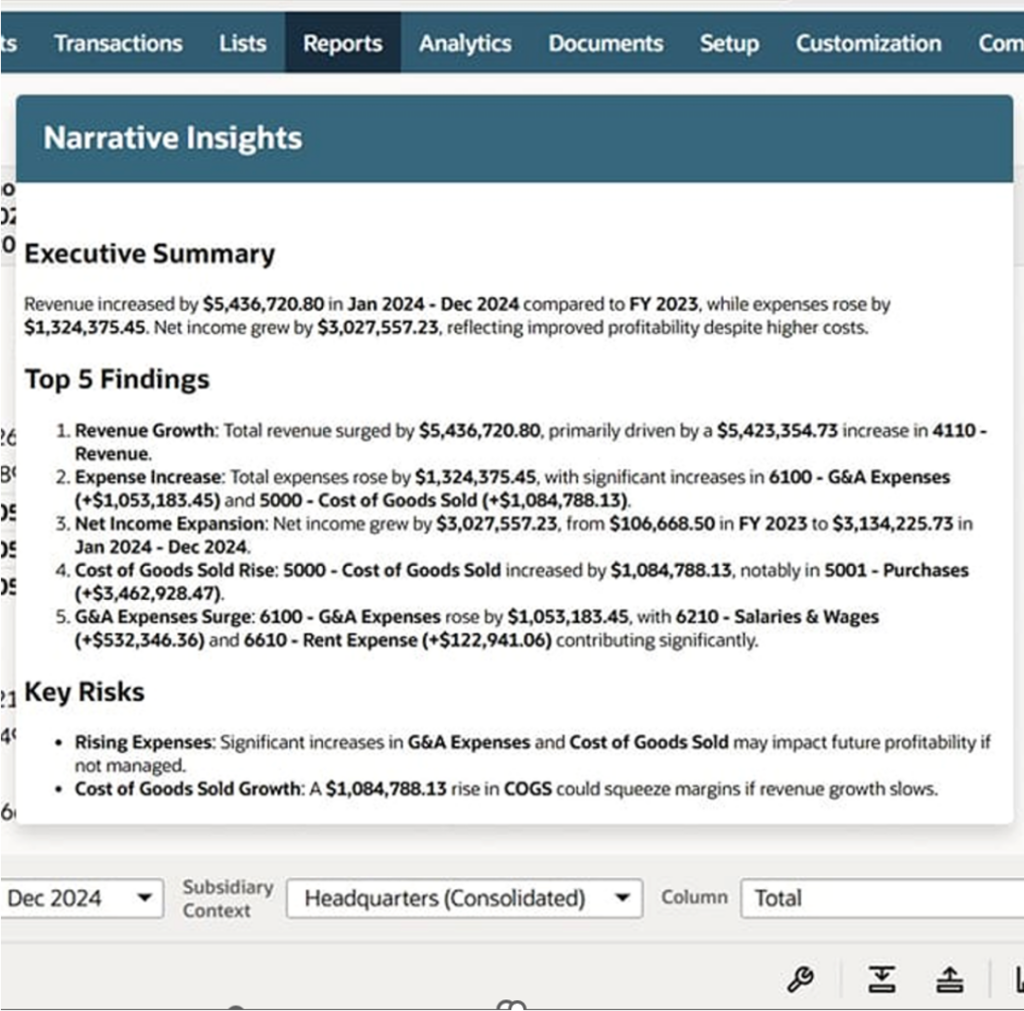
NetSuite now generates plain-language summaries directly within reports, including financial statements, inventory reports and operational dashboards, highlighting key drivers, risks and changes in performance.
Adoption outlook
Finance teams are not only producing numbers, they are expected to explain them. Automating part of that interpretation reduces the time spent preparing commentary and creates more consistency in how performance is communicated across leadership teams and boards.
Ready to use now?
Yes. Narrative insights are available now across multiple areas of the suite and are already one of the more accessible AI capabilities to adopt.
AI in planning, forecasting and cost analysis (EPM)
AI capabilities within NetSuite’s planning and budgeting tools explain how forecasts are generated, support cost allocation modelling and provide more transparency into financial planning outputs.
Adoption outlook
Forecasting is becoming more difficult in volatile conditions, particularly for ANZ businesses managing currency exposure, supply chain shifts and fluctuating demand. Greater visibility into how forecasts are built makes it easier to challenge assumptions, adjust quickly and maintain confidence in planning outputs.
Ready to use now?
Yes. These capabilities are available now as part of the latest EPM updates, though value will depend on how mature your planning processes are.
Get a personalised NetSuite pricing estimate
Receive a tailored NetSuite quote based on your business requirements, users, modules and implementation needs.
NetSuite AI Connector
The NetSuite AI Connector allows external AI tools such as Claude or other AI assistants to securely connect to your NetSuite environment and work directly with live business data.
In practical terms, this means you can ask an AI tool to analyse things like overdue invoices, customer payment patterns or inventory positions, and have it return structured outputs – dashboards, summaries or recommendations – using real-time NetSuite data rather than exported spreadsheets. Access is controlled through existing roles and permissions, so the AI only sees what the user is allowed to see, and all interactions remain governed within the system.
Adoption outlook
Most AI adoption today is fragmented. Teams export data, upload it into tools and work from static snapshots that are quickly out of date. At the same time, different parts of the business are often using different tools with no coordination, creating both inconsistency and risk. This connector addresses both issues. It allows AI to work with current, complete data while staying inside the same security model, audit trail and controls that govern the rest of the business. It also helps address what NetSuite described as a growing “governance gap”, where AI is adopted in an uncoordinated way across the organisation.
Ready to use now?
Yes. The AI Connector is available now for NetSuite customers in ANZ.
Autonomous close (future direction)
NetSuite is working towards an autonomous close, where AI agents continuously monitor transactions, flag exceptions and generate accruals throughout the period rather than relying on a month-end process.
Adoption outlook
Finance teams across ANZ are under pressure to support growth without expanding headcount. A continuous close model reduces reliance on end-of-month effort and shortens reporting cycles, which is particularly valuable in lean teams where the same people are responsible for both reporting and analysis.
Ready to use now?
Partially. The full autonomous close is still a future state, though capabilities like exception management and close monitoring are already available and forming the foundation.
NetSuite Next and embedded intelligence
Instead of relying on users to navigate reports or extract insights manually, NetSuite Next introduces a conversational interface through Ask Oracle, alongside AI agents that monitor activity, identify exceptions and propose actions within the context of the business. All of this runs on the same underlying data and permissions that already govern existing processes, which is what allows it to move from surface-level assistance into something operational.
This has particular relevance for finance teams, where the concept of an autonomous close begins to move into practice. Exception management, reconciliations and accruals are handled continuously across the period rather than concentrated at month end, changing not just the speed of reporting, but the rhythm of how finance operates. The implication is a redistribution of effort, with less time spent validating numbers and more time spent interpreting them, assuming the underlying data environment can support that shift.
MAAP – scaling without losing control
The customer panel brought these themes into focus through the perspective of Matthew Nott at MAAP, a business that has scaled rapidly across eCommerce, wholesale and retail while expanding into multiple international markets.
His experience reflects a common inflection point, where systems that supported early growth begin to constrain it, forcing a shift in how technology is evaluated. As Nott put it, “you really want to think about ensuring that your technology is going to enable your growth and not hold it back”, particularly when managing multi-entity structures, multiple currencies and increasing operational complexity.
The impact of that shift shows up most clearly in decision-making. With access to trusted, real-time data, speed and confidence improve materially. “Just how quickly we can make decisions… as opposed to a few years back when not only did you not trust the data, you didn’t even have it half the time,” he noted.
Inventory provided a more direct example of how system limitations translate into commercial outcomes. Previously, uncertainty in stock data required safety stock buffers across most products, constraining availability and tying up cash. With real-time integration across systems, those buffers were removed.
“We had to put safety stock buffers across just about everything… whereas now those are gone”, illustrating how improvements in data accuracy and visibility can directly affect revenue and working capital.
Read MAAP’s NetSuiite transformation with Annexa >
Continue the conversation
If you’re looking at how these capabilities apply in practice, particularly across finance, we’re running a session on how AI is being used today across reporting, forecasting and close. We’ll cover where it’s delivering value now, where it’s still evolving, and what to prioritise based on your current systems and processes.
Register for our AI in finance webinar >
Couldn’t make it SuiteConnect? Here’s the keynote from New York.