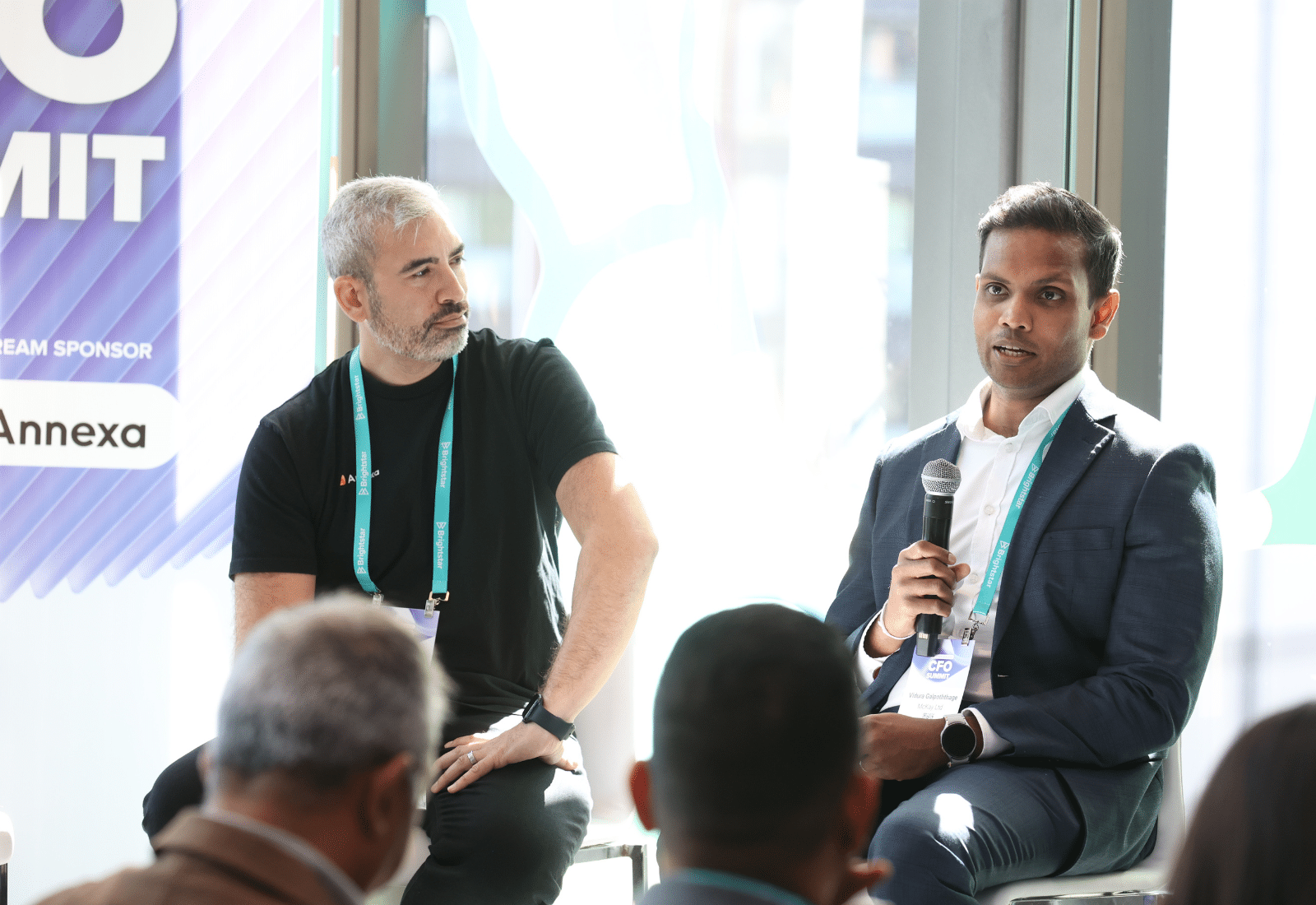

At September 8’s 2026 New Zealand CFO Summit, McKay presented a candid account of what happens when acquisition-driven growth accelerates faster than backend system capacity can handle. Vidura Galpoththage, Executive General Manager Finance and Commercial at McKay, and Ananda Iyer from Annexa spent 30 minutes unpacking how a 600-person infrastructure services company moved from three fragmented ERP databases to a single unified platform to solve a business problem: finance teams buried in data reconciliation have no capacity for strategic work.
The core issue was operational – when your finance team spends weeks reconciling data across systems, that team’s time disappears from activities that drive actual business decisions.
TL;DR
- McKay replaced three legacy Nimbus ERP databases with a unified NetSuite platform to support rapid acquisition-led growth
- Month-end consolidation reduced from eight working days to six; monthly forecasting became possible for the first time
- The transformation required standardising processes across branches and actively retiring legacy workarounds that had been digitalised rather than eliminated
Three databases created systematic integration friction
McKay’s infrastructure services operations spanning electrical contracting, engineering, maintenance and manufacturing across New Zealand, the US and the South Pacific had grown through acquisition, with each acquisition layering operational complexity onto technical fragmentation. The company ran three separate instances of Nimbus, a 1990s-era ERP designed for single-entity operations, alongside standalone payroll, CRM and manufacturing systems. Consolidating financial results across these databases required manual reconciliation between systems, approvals moved through Excel workarounds, and cash flow visibility lagged actual transactions by days.
The operational cost of this setup was measurable. Processing thousands of accounts payable invoices, purchase orders and job costing transactions, along with hundreds of AR invoices each month through disconnected systems created what Vidura described as a bandwidth constraint. The finance team’s calendar filled with data wrangling – confirming numbers matched between systems, reconciling between entities, waiting for consolidated reports to be assembled. That time allocation eliminated capacity for analytical work, forced cash flow decisions on incomplete information and extended acquisition integration timelines by months because the finance systems lacked the architecture to consolidate a new entity quickly.
ERP transformation as business transformation
What made McKay’s session valuable was Vidura’s clarity that moving to NetSuite OneWorld required treating the project as business transformation. Moving to a unified platform meant standardising finance processes, approval workflows and reporting structures across 11 branches that had operated with local autonomy. It meant systematically reviewing legacy workarounds to determine which created real control value and which represented simply digitalised inefficiency. It meant asking whether a process that worked 20 years ago still serves the business today.
This is where most ERP transformations encounter resistance. You can implement a new platform and end up with a more expensive version of the previous problem if you automate existing processes without questioning whether those processes should exist. McKay’s approach was more rigorous – standardise what the business required standardised, permit flexibility where specific operating units genuinely needed it and eliminate everything else. That meant conversations between finance leadership and branch managers who had run successfully for decades on independent P&Ls. It also meant training and change management to shift finance team mindsets from data production to data analysis.
The structural results tracked with precision
Once consolidated onto NetSuite OneWorld, month-end consolidation reduced from eight working days to six. The finance team produced monthly forecasts for the first time – a capability that required consolidated, reliable data available throughout the month. Real-time visibility into job costing, purchase order approvals and cash flow replaced the days-long reporting cycles that had defined prior operations.
The structural wins generated more value than the time savings. A unified platform meant acquired companies could be integrated into financial reporting in weeks. Approval workflows and audit trails replaced ad hoc spreadsheet controls. Cash flow forecasting and project profitability reporting moved from monthly estimates to daily certainty. And the finance team could conduct real conversations with operational teams about margin by project and working capital requirements on a current basis. Those conversations happened the week after month-end close, when the numbers still had operational impact. Previously those conversations happened 10 days after month-end when the period was closed and action was foreclosed.
The freed time compounded operationally when leadership redirected it toward analysis – which required treating the transformation as business change rather than a technology upgrade, shifting the finance function’s mandate from data production to data interpretation.
Designing systems for growth stages ahead
The observation that resonated most with the CFO audience was that you must design your financial systems and organisational structures for the growth stage you’re targeting, not the stage you currently occupy. Otherwise implementation completes with infrastructure already outdated relative to your actual growth trajectory.
That principle applies equally to acquisition planning, AI capability layering or structural reorganisation. The systems you deploy should give you room to scale. They should handle the complexity and transaction volume and entity count you’ll manage in two to three years, not just the complexity you manage today. McKay understood this when selecting OneWorld rather than a simpler platform – they required consolidation and multi-entity capability from day one because growth and acquisition were coming.
McKay’s priorities for the next 12 months
For the next year, McKay is deepening what the platform enables. This includes:
- Improving project visibility for operational teams so margin is accurate from the moment transactions post
- Strengthening purchasing and cost capture so project costs are visible in real time rather than discovered at reconciliation
- Reducing manual dependency on Excel by moving repeatable processes into the system
- Enabling project managers to read financial data from their projects, because managers who understand margin and working capital operate as system advocates rather than as obstacles to adoption.
Vidura argues CFO leaders should align internally on three structural changes: moving finance from data production to data interpretation, replacing consolidated reports with real-time operational dialogue, and building financial infrastructure that enables strategic work instead of just automating routine tasks.
NetSuite pricing for finance transformation
NetSuite OneWorld is built for multi-entity organisations managing complex finance operations across geographies and currencies. Implementation cost and licensing varies based on the number of entities, users, modules and customisation required. View NetSuite pricing to understand what a transformation comparable to McKay’s would cost for your organisation.
Next steps
If your finance systems are constraining growth, acquisition integration or real-time visibility, the McKay case study documents how another infrastructure services company moved from three fragmented systems to a unified platform. Contact our team to discuss what a comparable transformation could deliver for your organisation.
Frequently asked questions
How long does an ERP transformation typically take?
McKay’s initial implementation completed in 2022, with a second phase bringing manufacturing onto the platform in 2024. Most transformations span 6–12 months depending on the number of entities, legacy system complexity and scope of change management required. Go-live marks the beginning of optimisation work. The value compounds in the months after implementation when the team pushes the system’s capabilities and addresses processes that require refinement once real transaction volume flows through.
How do you approach legacy processes during implementation?
McKay standardised core finance processes across all branches while preserving critical customisations for specific business units. Every legacy workaround was explicitly reviewed with documentation of the control value it provided. That discipline matters because leaving old processes outside the system creates technical debt immediately: branches continue working around the new platform rather than within it, generating shadow systems that multiply support costs.
What happens to finance team workload?
In McKay’s case, month-end close workload dropped significantly because underlying transactions no longer required manual reconciliation between systems. That freed time compounds when leadership redirects it toward analysis and strategic work. Achieving that redirection requires explicit change management and training focused on shifting mindset from data production to data interpretation. The tools exist; the mindset shift requires intentional leadership.
Can NetSuite scale through planned acquisitions?
Yes. A unified ERP platform functions as your integration engine for acquisitions. When a new company joins the group, it can be brought onto the same platform in weeks rather than months. This was McKay’s structural advantage: each acquisition became easier to integrate because the financial infrastructure was already designed for multi-entity consolidation.
How do you achieve operational team adoption?
You direct attention to how project managers and branch leaders actually use financial data. A branch manager who has run a successful P&L for 20 years will adopt the system when the system makes their job clearer, when they can see project profitability in real time, when they can make decisions on current data. That requires teaching operational teams to read financial data from their projects. Project managers who understand margin and working capital become advocates for the system.
Where does AI fit into ERP transformation?
McKay has layered AI on top of its NetSuite foundation through exception reporting in accounts payable that flags unusual transactions for human review and learns from feedback. The prerequisite is clean data and stable processes. AI applied to messy fundamentals simply scales the errors. Sequencing matters: platform stability comes first, then optimisation with technology. Build the foundation correctly, and AI capability becomes an accelerator.