
Every year the Annexa team heads out on the road for Annexa On Tour, making a series of stops across Australia and New Zealand to share everything that’s shifting inside the NetSuite ecosystem. This year saw our biggest turnout yet, with full rooms in Melbourne, Sydney Brisbane and Auckland.
If you couldn’t make it or need a refresher, here’s an in-depth breakdown of all that was shared.
Get a personalised NetSuite pricing estimate
Receive a tailored NetSuite quote based on your business requirements, users, modules and implementation needs.
Big moves in Oracle’s cloud and AI strategy
Oracle’s broader cloud momentum grounded the start of the day. Beyond briefly making Larry Ellison the richest man in the world, the headline-grabbing 455-billion-dollar RPO (Remaining Performance Obligations) figure tells a much bigger story. It showcases Oracle’s commitment to continuous innovation by locking in enormous cloud and AI contracts with major hyperscalers and AI firms including OpenAI and Meta.
And for NetSuite, this is all very good news!
Oracle’s investment into AI is flowing straight into NetSuite, and sets a strong foundation for anything built on top of Oracle’s infrastructure.
Partnerships are also reinforcing momentum into AI advancements. Oracle is working more closely with industry leading organisations , some even traditionally viewed as competitors, and is positioning itself firmly amongst the worlds top platforms.
One of the biggest technical shifts is the rollout of the autonomous database into NetSuite. This means the platform can handle richer data types across text, audio, video and unstructured information. It opens the door to more accurate search, better recommendations and smarter AI agents embedded in day-to-day workflows.
Security and scale are also shaping adoption. Because NetSuite sits on the same infrastructure stack as Oracle, customers gain the same reliability, performance and governance without stitching together external tools or rethinking their architecture.
For NetSuite customers, this all adds up to a faster-moving roadmap. New capabilities can land more smoothly, AI features arrive with less disruption and the platform’s unified data model becomes even more valuable. It sets NetSuite up for a period of accelerated innovation – a theme that carried through the rest of the day.

Oracle’s AI foundation & infrastructure
A unified platform built for AI
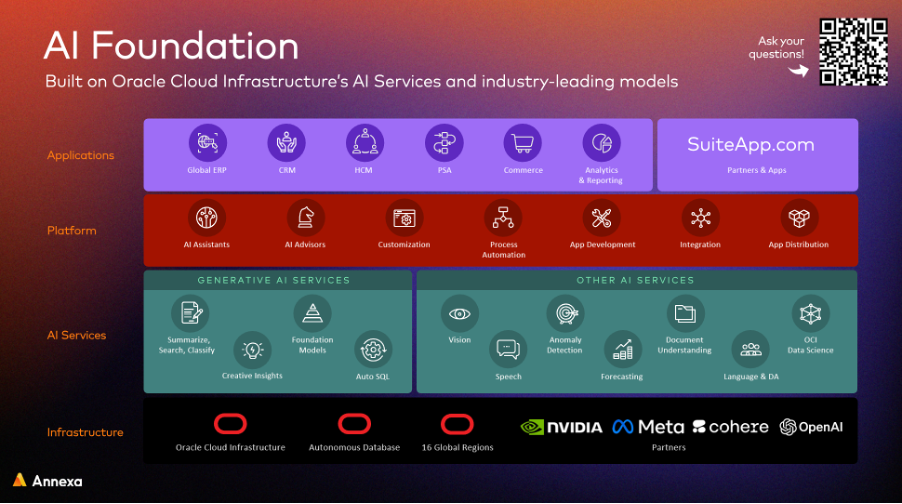
NetSuite touched on this earlier, but it’s worth reinforcing. Because everything runs on a unified data model, AI services can see the full picture of how a business operates. That context is essential. If an AI model only understands one slice of your data, it can’t make accurate decisions or execute tasks reliably.
This is why NetSuite’s approach works so well for agent-based automation. AI doesn’t just see a transaction. It sees the customer, the supplier, the inventory impact, the GL behaviour, the historical patterns – all the things that shape a good decision.
The other perk to this comprehensive infrastructure is businesses don’t have to expose sensitive information outside of NetSuite. With platforms like Cohere and OpenAI embedded, it allows data to stay within walls of NetSuite and reduces the need to link to third-party platforms.
Five stages of approaching AI
To make the AI journey clearer, we broke it down into five stages that reflect the type of value AI delivers:
- Analyse – AI interprets live NetSuite data to identify trends, movements and risks
Example: explaining CAPEX variance, forecasting demand, predicting cashflow movements - Advise – insights appear inside workflows, not in separate dashboards
Example: warning about stock shortages, flagging collections risks, highlighting financial exceptions - Assist – AI starts performing steps in your processes
Example: categorising transactions, preparing reconciliations, generating journals for review - Autonomy – agents act as digital team members with oversight
Example: creating and approving POs within limits, running collections workflows, preparing month-end journals and reconciliations - Expert – AI becomes a specialist layer guiding complex decisions
Example: scenario modelling, interpreting variances, orchestrating multi-step processes end-to-end

What makes this possible inside NetSuite
We also walked through the toolkit that enables this shift:
- NetSuite LLM – a large language model hosted inside your NetSuite environment, keeping sensitive financial data inside your own tenant
- Model Context Protocol (MCP) – the framework that lets AI securely understand NetSuite’s business objects and relationships
- Multi-model support – access to other AI models like OpenAI, Claude and Cohere, allowing us to choose the best model for each use case
- AI development tools – giving Annexa the ability to build agents, advisors and automations directly on top of your environment
- Generative + vision AI – to produce insights, draft communications or even analyse images for quality checks
- Cross-system integration – agents that can talk to systems beyond NetSuite (CRM, eCommerce, payments, workforce tools) to complete multi-step tasks
The combination of unified data + modern AI tooling + multi-model flexibility is what unlocks real automation rather than surface-level insights.
How Annexa is leveraging AI & innovation
We also outlined the direction our product team is taking into 2026. The focus is on practical intelligence – tools that sit inside daily finance workflows and remove friction rather than create new systems. That includes expanding our agent library, deepening MCP integration, refining our LLM workspace and building more automation around reconciliations, approvals and cashflow. These are real tools shaped by real customer needs, and they’ll continue rolling out through 2025 and 2026.
We can’t share everything publicly yet but if you would like to learn more about our innovations or be involved in our beta programs, please reach out to us.
The key updates from SuiteWorld 2025

SuiteWorld gave us a clearer view of what’s coming and the AI direction is unmistakable. Throughout the day we focussed on what the new products and capabilities look like in practice. Let’s take a look!
NetSuite Next

NetSuite Next is the centrepiece of the roadmap. It’s a refreshed, AI-ready interface built on Redwood that makes NetSuite feel cleaner, faster and more consistent across modules. The redesign reorganises information using clearer layouts, modern UI patterns and more visual context so users can move through processes with less friction.
But the big shift is that NetSuite Next becomes the default home for Ask Oracle, agents and narrative insights. It positions the ERP as an environment where AI sits in the flow of work instead of added on through separate tools or menus. The early preview screens made it clear that reporting, transaction review and cross-entity navigation will all feel more streamlined.
Rollout begins late 2025, but don’t expect it to hit APAC shores until late 2026 or 2027.
Ask Oracle

Ask Oracle is quickly becoming the AI entry point for the whole system. Instead of digging through menus or building saved searches, you’ll be able to ask questions in plain language and let the model analyse data, surface results and generate follow-ups.
Ask Oracle can look across subsidiaries, customers, transactions and forecasts, then suggest the next question you should be asking. It’s the first step toward a conversational layer that understands context from the unified data model and sits across every role and department.
Like NetSuite Next, don’t expect it to hit APAC shores until late 2026 or 2027.
Autonomous Close

Autonomous Close showed one of the clearest examples of how NetSuite plans to embed agents into finance workflows. The close process is broken into agent-addressable tasks – variance checks, journal prep, reconciliations, review flags – and the system can run these automatically, surfacing the exceptions for human oversight.
The value here is obvious for any finance team juggling complexity across entities or currencies. Instead of manually chasing each step, the close becomes a coordinated set of small autonomous jobs, each with auditability and controls wrapped around it.
Autonomous Close is scheduled to arrive in ANZ in 2026 – 27.
Intelligent Payment Automation

This update focuses on AP efficiency. Intelligent Payment Automation uses AI to look across upcoming payables, cashflow, due dates and vendor behaviour to recommend – or eventually schedule – the right payment timing.
The workflow can analyse invoice patterns, identify early payment benefits, highlight risk or consolidate payments to reduce processing effort. In the long run, this becomes one of the building blocks for fully autonomous AP – matching, scheduling, paying and posting with minimal touch.
This sits inside the broader move toward AI-assisted transactional finance but no word on when ANZ will have access.
AI Connector – Available now!

The AI Connector bridges NetSuite with external AI models through a governed interface. It lets teams create prompts, pass NetSuite data into a model, and return results back into the system – all within a controlled, auditable framework.
This is important because it reduces the risk of uncontrolled integrations or manual copy-paste workflows into external AI tools. Teams can experiment, automate and build AI-enabled steps without stepping outside NetSuite’s guardrails.
It’s available now and already being used for tasks like generating customer communications, summarising transactions and producing operational insights.
Project Profitability

Project profitability reporting is getting a lift with automated summaries that combine financial results with narrative explanations. You’ll see clear takeaways at a glance – which projects drove margin, which ones slipped, where variances came from and what needs attention next. Instead of interpreting dozens of line items, the system generates a digestible written summary that speeds up review cycles and makes performance conversations more data-driven.
SaaS 360 Dashboard

The SaaS 360 Dashboard consolidates subscription, retention and billing performance into a single workspace for software companies. It pulls together ARR, churn, renewals, expansion, customer health and cohort-style metrics that SaaS operators normally track manually in spreadsheets or BI tools.
The update makes this analysis native to NetSuite, with clearer visualisations and drill-downs. For SaaS teams running billing, finance and CRM across NetSuite, this gives them a much tighter operational view without leaving the platform.
Cash predictions

Cash Predictions uses machine learning to analyse patterns across invoices, payment history, customer behaviour and seasonality to forecast cashflow. It does this at a more granular level than the traditional Cash 360 dashboard because it uses behavioural signals to predict when payments are actually likely to arrive.
This helps finance teams get ahead of shortfalls, prepare for lumpy inflows and shape payment strategies earlier in the cycle. It’s a step toward a more intelligent treasury layer inside NetSuite.
NetSuite Integration Platform (NSIP)

NSIP continues to evolve as NetSuite’s integration backbone. The SuiteWorld update focused on easier connections, prebuilt accelerators and more consistent governance across integrations.
It’s positioned as the long-term direction for connecting NetSuite with external systems, replacing older integration approaches with something more secure, more scalable and easier to maintain.
E-Invoicing

E-Invoicing continues to roll out region by region, with regulatory alignment baked in. The latest update added a tighter Avalara integration, cleaner invoice validation and more structured workflows.
This is increasingly important as compliance expectations rise and as countries move toward mandatory e-invoicing frameworks. NetSuite is continuing to build this into native processes rather than add new solutions.
AI Agents – operational agent

Operational agents will move beyond analysis and actually run defined tasks. The example we shared focused on fulfilment and production – selecting orders, triggering warehouse waves, creating purchase or transfer orders to meet demand, reprioritising based on business objectives and scheduling production to maximise throughput. It highlights a future where agents handle routine orchestration and teams only step in when oversight or judgement is needed.
Narrative insights

Narrative insights apply generative AI to traditional NetSuite reports, transforming dense tables into plain-language explanations. The tool highlights key points, unexpected results, emerging risks and recommended next steps. It turns what used to be a manual “write-up” job into an automatic layer of intelligence that helps teams quickly understand what changed and why – and gives executives a cleaner way to consume operational data.
Outlook integration

The new Outlook connector gives sales and service teams a much tighter connection between email and NetSuite. You can match inbound emails to existing records, create new customer or prospect records directly from Outlook, attach files and sync the full conversation thread into NetSuite without leaving your inbox. It reduces double entry, improves CRM data quality and helps front-line teams keep NetSuite updated as part of their natural workflow.
Other highlights from SuiteWorld

A few smaller, yet meaningful features also landed. These updates give teams more predictability, more accuracy and more automation without needing new modules or major rework.
Taken together, these updates show how quickly NetSuite is embedding AI, cleaning up processes and modernising the experience across modules.
What landed in the latest NetSuite release
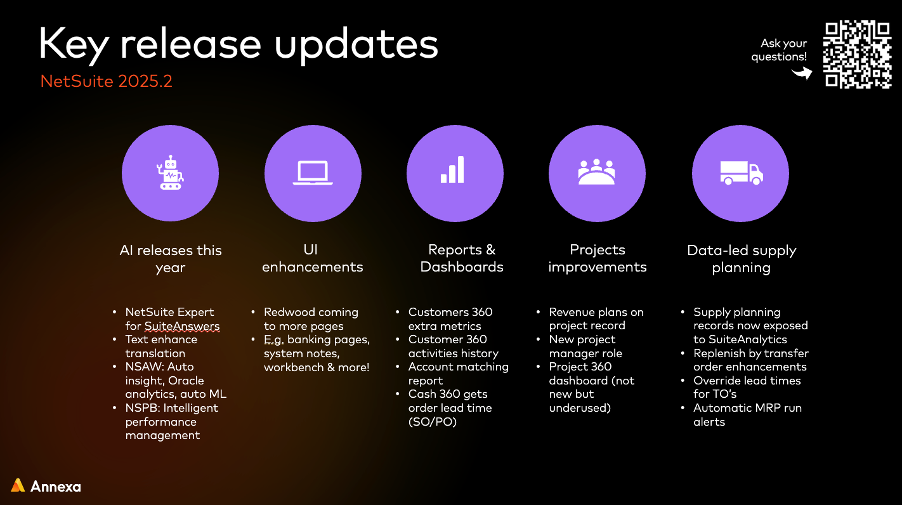
This year saw meaningful improvements across the releases. NetSuite is clearly shifting at a faster pace, often releasing major capabilities ahead of SuiteWorld because the speed of AI innovation demands it. MCP and the AI connector were good examples – both arrived early because waiting for a conference cycle wasn’t an option.
AI continued to dominate the release notes. SuiteAnswers gained a new AI-first search experience that behaves much more like a modern search engine, surfacing an instant AI summary before linking to the underlying articles. Text Enhance expanded again across communications and Prompt Studio. New AI features also rolled out across NSAW, NSPB and NSAR as Oracle pushes more of its enterprise AI tooling down into the NetSuite stack.
Redwood is becoming the standard interface across new pages and apps, with improved performance and a cleaner design. SPA is also reshaping how new SuiteApps are delivered through a modern, dynamic front-end that updates content instantly without full page reloads. The net effect is an experience that feels faster, more modern and more app-like than the older multi-page UI.
Other key highlights include:
- NetSuite Expert – You will be familiar with SuiteAnswers, the wiki-style help in NetSuite you can use to look up things that might not be in standard manuals. Things like what different errors mean or how to make a particular kind of custom report. NetSuite Expert takes it one step further. Instead of looking up different articles by keywords, you can ask it natural language questions and it will look up the relevant articles and combine them for you into an answer.
- NetSuite Planning and Budgeting (NSPB) – For teams using NSPB or considering it, the new intelligent performance management capabilities now generate predictions and surface insights automatically. It can model your sales trajectory for the rest of the financial year, show where you’re tracking against forecast and flag potential shortfalls early, backed by the detailed data behind the predictions.
- Customer 360 – The latest updates add new metrics and insights, along with drill down to workbook capability. You can now explore customer activity in much more detail, with drill down available for orders and returns, open invoices, overdue invoices and available credit memos.
- Account Matching Report – A new SuiteApp designed to tighten sub-ledger and GL alignment. It gives a clear view of invoice–payment matching and GL impacts across AR and AP. It’s free, quick to install and designed to simplify reconciliation checks.
- Cash 360 – Expanded to include sales orders and purchase orders so projections reflect more real-time operational demand. The app has matured noticeably over recent releases and is becoming a strong option for teams not yet using NSPB.
- Project licensing updates – NetSuite introduced a dedicated Project Manager licence at around half the cost of a full user. It finally gives project-focused teams a licence model that matches their actual role and access needs.
- Data-led supply planning – The newer workbench continues to replace the long-standing demand planning module. NetSuite is investing heavily here, adding more intelligence, improved lead-time handling and a more intuitive workflow.
What the NetSuite EPM suite is now delivering
Next up, we walked through the broader EPM suite – from Planning & Budgeting through to Account Reconciliation and the latest narrative automation tools – all designed to give finance teams more control and less spreadsheet chaos. The thread running through all of it is intelligence. Forecasts that adapt to real-world performance, reconciliations that flag anomalies early, reporting packs that build themselves and a data warehouse that frees the ERP from carrying volumes of operational detail.
We’re seeing more customers adopt these tools with strong results.

NetSuite Analytics Warehouse (NSAW)

NSAW came up first as the analytics backbone for the whole EPM stack. It pulls NetSuite and third-party data into an autonomous warehouse, giving finance teams a cleaner, faster way to run reporting without weighing down the ERP. NSAW is made to scale by providing one environment for financial and operational reporting, better data modelling and pre-built dashboards that surface trends without heavy BI tooling. It’s the part of the suite that turns raw data into something genuinely usable.
Narrative reporting

Narrative reporting is maturing into a tool that helps teams tell the story behind the numbers. It brings everything into one place, combining narrative commentary, financial statements and operational data. The new visualisations make complex information easier to interpret and the collaboration layer means finance teams can draft, review and publish reports without version chaos. It’s designed to speed up the reporting cycle without sacrificing depth.
NetSuite Account Reconciliation (NSAR)

The reconciliation updates reinforced just how far NSAR has come. The latest updates focus on tighter compliance, higher accuracy and automated steps that reduce manual matching. Real-time visibility across reconciliations makes exceptions clearer, and the improved dashboards highlight performance, bottlenecks and risk. For teams managing multiple entities or high transaction volumes, this cuts down the noise and reduces the chance of errors slipping through.
NetSuite Planning & budgeting (NSPB)

NetSuite Planning & Budgeting continues to expand as more intelligence flows into the platform. The latest release introduced SuiteQL-based data loading, native scheduling of pipeline jobs and improved sync behaviour between NetSuite and NSPB. Multivariate predictions and deeper scenario capability now give teams a far more intelligent forward view, reinforcing NSPB’s position as one of the most advanced planning tools in the mid-market.
If you want a little more detail here, read the deep dive covering how Kieser has transformed with NSPB.
The customer insights panel
One of the best parts of Annexa On Tour is hearing directly from customers about what they’re working on and how they’re using NetSuite. This year didn’t disappoint. We heard from Hairhouse, Car Group, Boody, Smithbridge Group, McKay and Dominion Salt as they shared practical lessons, challenges and wins from their own transformations. A big thank you to everyone who joined us on the panel!
Our valued event sponsors
A huge thank you to each of our event sponsors – Celigo, FloQast, Avalara and RF-SMART – whose expertise and partnership continue to strengthen the NetSuite ecosystem.
- Celigo provides integration and automation tools that connect NetSuite with your wider tech stack so data moves cleanly between systems without manual work.
- FloQast streamlines the financial close with workflow automation, reconciliation tools and centralised task management for accounting teams.
- Avalara automates tax calculation, compliance and reporting so businesses can manage GST, sales tax and cross-border rules directly from NetSuite.
- RF-SMART delivers mobile inventory and warehouse management for NetSuite, giving teams real-time scanning, visibility and control across every movement.
A growing community across every stop
What stood out across the tour was the openness of the conversations. Each stop brought a different set of challenges, ideas and lessons, and the willingness to share what’s working – and what isn’t – continues to shape how we support the wider NetSuite community. With AI accelerating across both NetSuite and Annexa’s own roadmap, 2026 is shaping up to be a hugely transformational year for finance and operations teams across ANZ.
Want more information of the content presented?
If you want to dig deeper into anything we shared, your Customer Success Manager is the best place to start.