

AI is moving quickly from something businesses experiment with to something that can analyse operational data, make recommendations and increasingly take action inside everyday workflows. But there is a less exciting question businesses need to answer first – is the data underneath it actually ready?
That was the focus of the third webinar in Annexa’s AI series, AI is only as good as your data: a roadmap for data readiness, hosted by Ananda Iyer, Head of Customer Success, with Will Goodbourn, Solution Architect, and Louis German, Delivery Lead.
During the session, the panel looked at why fragmented business data becomes a bigger problem as AI takes on more responsibility, what an AI-ready data foundation actually looks like and where businesses can start improving it.
TL;DR
- Most businesses in our webinar still move data between systems by spreadsheet, and only 7% rated their data ready for AI
- AI inherits whatever data it is given, so the risk grows as it moves from answering questions to taking action
- Five foundations decide whether AI can be trusted, and the first step is agreeing what AI may touch, own and decide
Most businesses are starting with a fragmented data landscape
Business systems rarely become complicated by design. As Will explained during the webinar, the problem usually develops gradually. A growing business introduces a CRM to solve a sales problem, an inventory or forecasting platform for operations, perhaps a payroll system, eCommerce platform or specialist application. Expansion into new regions, entities or revenue streams adds even more.
Individually, those decisions can make perfect sense. The problem appears when the systems stop sharing information cleanly.
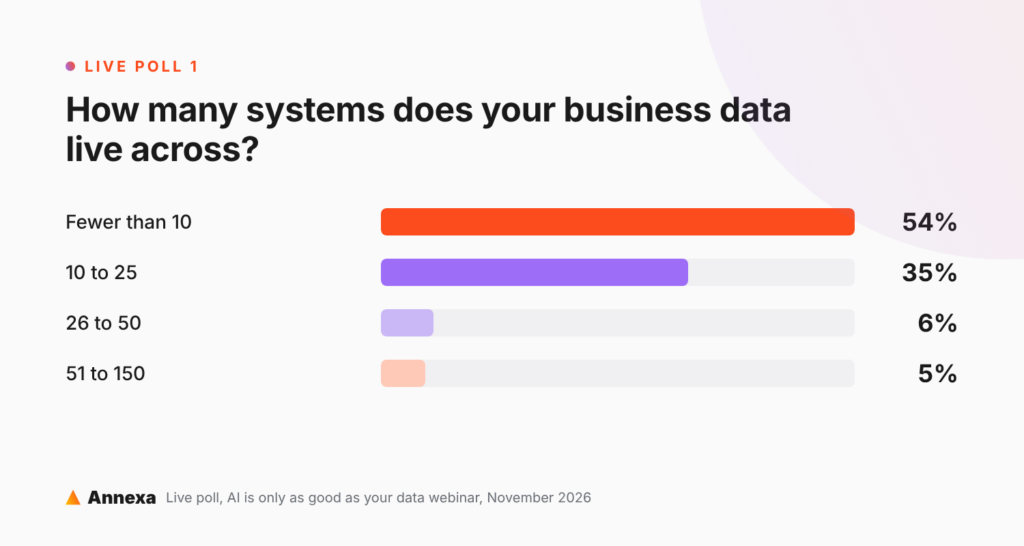
The number itself isn’t necessarily the issue. As Will put it during the session, multiple systems are not inherently a problem, disconnected systems are. Different systems can end up holding different versions of customer, product, transactional and financial information, forcing people to re-enter, reconcile or reinterpret data before it can be used reliably.
The way businesses in the webinar move data between those systems shows how much manual work remains.

This matters because integration is not only about moving data. The business also needs to know which system owns each record, how information is mapped between applications and what happens when an integration fails. The Annexa data readiness checklist calls out automatic data exchange, integration direction and frequency, manual CSV exports and re-keying, reconciliation and data timeliness as areas to assess.
AI won’t fix poor data
This is where data quality becomes an AI issue. If a business has duplicate supplier records, inconsistent customer information or outdated data, giving an AI tool access to it doesn’t clean those problems up. As Louis explained during the webinar, AI can return an answer extremely quickly, and that speed says nothing about whether the underlying information was trustworthy in the first place.
Consider asking AI why margin dropped during the month. If finance, sales and inventory are operating from different versions of the data, the first problem isn’t the quality of the AI model. It is determining which version of the business the AI is analysing.
That becomes considerably more important as businesses move beyond AI that generates an answer. AI agents can prepare or take the next step in a workflow, and a single process could touch an ERP, CRM, warehouse system or other operational platform. The reliability of the underlying data and the controls governing those connections become part of the AI architecture itself.
Five foundations of AI-ready data
During the webinar, wen outlined five areas businesses can use to assess their foundations.
| Foundation | What to check | Where it usually goes wrong |
|---|---|---|
| Systems and reconciliation | Which record wins when two systems disagree on a customer, supplier, inventory or financial record | Finance reconciles competing versions every month before reporting can begin |
| Multi-entity data | Consistent structures for consolidation, intercompany transactions, currencies and entity data | Consolidation starts in a spreadsheet |
| Chart of accounts and dimensions | Accounts, departments, classes, locations and subsidiaries defined and used the same way everywhere | A reporting structure designed years ago for a smaller business |
| Master data | Customers, suppliers and items with one definition: naming, terms, currencies, SKUs, categories, units, pricing | Duplicates across systems and nobody owning the list |
| Access and audit trail | What AI can read, what it can change, which actions need approval and whether they can be traced | AI tools sitting outside the governance that applies to people |
The biggest gaps usually sit was master data and reporting structures, because they were set up for the business at an earlier stage and nobody owns keeping them consistent. Good foundations are an ownership question before they are a technology question.
The aim isn’t necessarily to put everything into one system
One of the important distinctions made during the session was between one system and one source of truth. A specialist platform can still make sense where it performs an important job for the business. In a retail environment, for example, detailed customer behaviour may belong in a specialist marketing platform rather than an ERP. The question is whether each system still earns its place and whether the business has clearly defined which platform owns each type of information.
The ERP can remain the core system of record, with specialist platforms connected around it. For each application, businesses can ask three questions:
- What job does this system do?
- Is it still adding enough value to justify its place?
- Could the core platform now perform that job instead?
The objective is not automatically to reduce the stack to a single application, it is to remove unnecessary duplication and create a dependable source of truth across the systems that remain.
Integration needs to be designed around ownership
The webinar also highlighted a sequencing problem – connecting systems before fixing the underlying data can spread the problem. If duplicate supplier or customer records already exist, an integration distributes those duplicates into more systems.
Other common problems discussed included two applications both behaving as the master record, undocumented field mappings causing reporting discrepancies and integration errors going unnoticed until month end.
For simpler environments, point-to-point connections may be sufficient initially. As the number of systems grows, those connections become harder to track and maintain. An integration platform provides a central place to manage how information moves, where errors land and how mappings change, and in practice many businesses end up with a hybrid environment that combines managed integrations with pre-built connectors where the flow is standard.
The objective is the same either way – create the data once and allow it to move through the business consistently.
Governance becomes more important when AI can act
The third live poll showed security and control are already firmly on the agenda.

The panel’s advice was to avoid building an entirely separate governance model for AI. AI should inherit existing role-based access and permissions rather than bypass them and organisations need an audit trail of what happened, what information was used and what action was taken, particularly as AI moves from making recommendations to executing tasks.
Human approval is another deliberate design decision. The checklist asks businesses to determine which AI recommendations can proceed automatically and which require someone to review them first. A useful way to think about that is to separate recommendation, approval, execution and review, rather than treating AI involvement as a single step.
Get a personalised NetSuite pricing estimate
Receive a tailored NetSuite quote based on your business requirements, users, modules and implementation needs.
Only 7% said their data was ready
The final poll gave perhaps the clearest picture of the challenge.

That doesn’t mean businesses need to stop experimenting until every dataset is perfect.
For organisations that are partly ready, Louis recommended starting where the data is already solid. Test AI against questions where the answer is already known and check whether the result matches. Where it does not, you’ve identified a specific data weakness to address before widening the use case.
For businesses further back, Will recommended first agreeing some basic principles around AI – what data it can touch, what AI is allowed to own, where a human needs to remain involved and where the organisation is comfortable experimenting.
The goal is incremental progress rather than trying to clean the entire organisation’s data estate in one project.
Start with the data beneath the use case
Amongst our attendees, skills and know-how, security and governance, and data quality and integration were the major themes identified when asked what was preventing them from using AI.
The practical starting point is therefore not necessarily selecting another AI tool. Choose the business process you want to improve. Identify the information that process depends on. Establish which system owns it. Check its quality, how it moves between systems, who can access it and what controls should apply if AI begins acting on it.
Annexa’s AI Data Readiness Checklist turns those questions into a practical assessment covering structure, master data, connected systems, governance and AI readiness.
For some businesses, the next step will be cleaning up data and improving the integrations they already have. For others, particularly where multiple entities, complex reporting, inventory requirements or workarounds have outgrown the existing accounting platform or legacy ERP, it may be time to reassess whether the core system is still fit for the business.
Either way, the principle from the webinar remains the same – before asking what AI can do for your business, make sure you can trust the data you’re asking it to work with.
Frequently asked questions
What does AI-ready data mean?
Data that is consistent across the systems AI will read, with one owner for each record type, a reporting structure that reflects how the business operates today, and access controls and an audit trail covering what AI can see and change.
Do we need fewer systems before we can use AI?
No. Specialist systems that add value can stay. The goal is one source of truth with the ERP as the system of record and the other systems connected to it, so data is created once and moves consistently.
Where should a business start?
Agree what AI is allowed to touch, own and decide in your organisation, then pick one process, check the data it depends on against the five foundations, and test AI on questions where you already know the answer.
Can a business on Xero or MYOB be AI-ready?
Yes, to a point. Cleaning master data and connecting the systems that need to share information gets a business a long way. The limits appear with multiple entities, consolidation, inventory and more complex reporting, which is when the core platform needs reassessing.