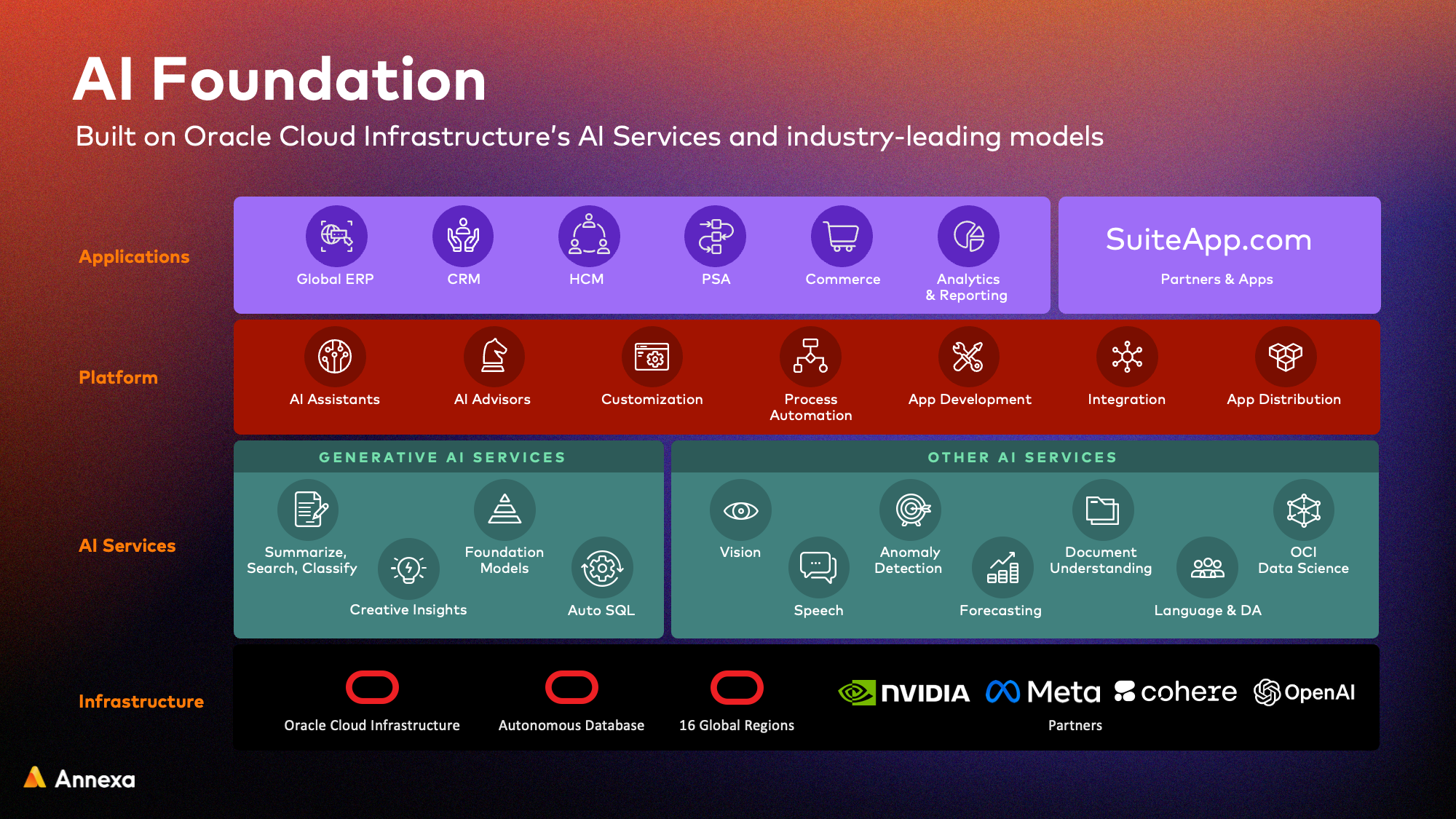
NetSuite’s approach to AI over the past few years has been cautious and incremental. A generative summary here. Some automation there. Useful, but often easy to miss or locked behind modules not widely used. For most finance and operations leaders, it felt more like background enhancement than a change in how the ERP actually worked. That changed in 2025.
With the announcement of NetSuite Next, Oracle NetSuite signalled a clear shift in direction. Rather than adding isolated AI features, it is embedding reasoning, conversational interaction and agent-driven workflows directly into the core of the platform. If it delivers as positioned, NetSuite moves from being a system that records transactions to one that explains what’s happening, proposes what to do next and, within defined guardrails, takes action.
As we move through 2026, AI is no longer experimental or limited to narrow use cases. The technology has matured, governance has improved and the value across finance, ecommerce and operations is now tangible.
This article sets out what NetSuite AI can already do, what’s coming next, and how to prepare so you start 2026 ready to adopt rather than react.
NetSuite AI you can use today
Several NetSuite AI capabilities are already live or rolling out now and are useful for removing friction from everyday finance and planning work.
Contextual insights in NetSuite Analytics Warehouse
NetSuite Analytics Warehouse is NetSuite’s cloud-based reporting and analytics layer, used by finance and operations teams that need deeper analysis across entities, channels and data sources than standard reports allow. It consolidates NetSuite data alongside third-party sources such as CRM, ecommerce and marketing platforms, and is typically used for management reporting, performance analysis and planning.
In NetSuite 2025.2, NetSuite introduced AI-driven Contextual Insights. This capability automatically analyses selected data and compares it to the wider dataset, surfacing what is genuinely different rather than leaving users to hunt for it themselves. The system highlights top variances, correlations, 80/20 breakdowns and patterns, presenting insights in ranked order with supporting visualisations.
In practical terms, this means a finance team can look at a subset of revenue, customers or products and immediately see how it behaves compared to the rest of the business. For example, comparing online sales against retail stores, or identifying which factors are most strongly correlated with margin movement. Instead of building multiple comparison reports, the insight comes to the user.
The value here is focus. Analytics Warehouse has always been powerful, but Contextual Insights reduces data noise and shortens the path from question to answer. Finance and operations leaders spend less time interpreting charts and more time understanding why performance is shifting and where attention is needed.
Availability: released in NetSuite 2025.2 and available now, subject to Analytics Warehouse adoption in ANZ.
Multivariate forecasting in NetSuite Planning and Budgeting
NetSuite Planning and Budgeting is used by finance teams to manage budgeting, forecasting and scenario modelling across the organisation. It typically replaces spreadsheet-driven planning by centralising assumptions, drivers and approvals inside the ERP environment.
Recent updates introduced AI-powered multivariate forecasting. Instead of modelling individual drivers in isolation, the system analyses how multiple related factors move together over time. Sales, marketing spend, headcount, inventory and other inputs are evaluated as a connected system rather than independent lines.
In practice, this produces forecasts that better reflect how the business actually operates. A change in demand automatically influences inventory, cash flow and resourcing assumptions without finance teams rebuilding models manually. Scenario planning becomes faster and more credible because the relationships between drivers are baked into the forecast.
Availability: live now.
GenAI summaries in NetSuite Close Management
NetSuite Close Management is designed to coordinate and track the month-end close process. It provides visibility into close tasks, dependencies and exceptions across entities and teams, helping controllers manage progress and risk.
With the 2025.2 release, NetSuite added GenAI-powered summaries to Close Management. The system now interprets complex job logs and system messages, translating them into plain-language explanations. It highlights errors, identifies blockers and suggests next steps without requiring users to dig through technical detail.
For finance teams, this removes one of the most time-consuming parts of close – working out what failed, where, and why. Instead of chasing logs or relying on technical specialists, controllers get immediate clarity on issues that need attention.
Availability: released in NetSuite 2025.2 and available now.
NetSuite Text Enhance and document intelligence
NetSuite Text Enhance and document intelligence capabilities focus on one of the least visible but most expensive problems in finance operations – manual handling of text and documents.
Text Enhance provides AI-powered translation across 22 languages and can translate fields on demand within NetSuite. Through the SuiteScript GenAI API, these capabilities can also be embedded into custom workflows and extensions.
Alongside this, the Document Intelligence API allows NetSuite to extract and summarise information from structured and unstructured documents such as invoices, contracts, receipts, PDFs and images stored in the system.
Information that once required human review is now surfaced automatically and fed into downstream workflows, reducing manual effort across accounts payable and expenses.
Availability: live, with APIs available for custom use cases.
NetSuite Subscription metrics with AI-generated narratives
NetSuite Subscription Metrics is a pre-built SuiteApp designed for SaaS and recurring-revenue businesses. It provides over 40 standard KPIs including MRR, ARR, churn, net revenue retention, CAC payback and LTV, all calculated directly from NetSuite data.
What’s changing is the addition of AI-generated narratives that explain movements in those metrics. Rather than presenting numbers in isolation, the system will surface commentary on what changed, where, and why, based on underlying drivers and trends.
For finance teams, this reduces reliance on offline analysis and spreadsheet commentary when reporting to executives or investors. The ERP becomes the source not just of metrics, but of interpretation.
Availability: Subscription Metrics is available now at no additional cost. AI-generated narratives are expected to roll out over the next year.
NetSuite AI that is coming and why it is different
The next wave of NetSuite AI focuses less on individual features and more on how users interact with the system.
NetSuite Next as an operating mode
It’s not a new product or module, rather NetSuite Next is an operating mode that customers can enable within their existing NetSuite instance. When switched on, it introduces conversational AI, agent-driven workflows and a modernised user interface, all working on the same data, roles and permissions already in place.
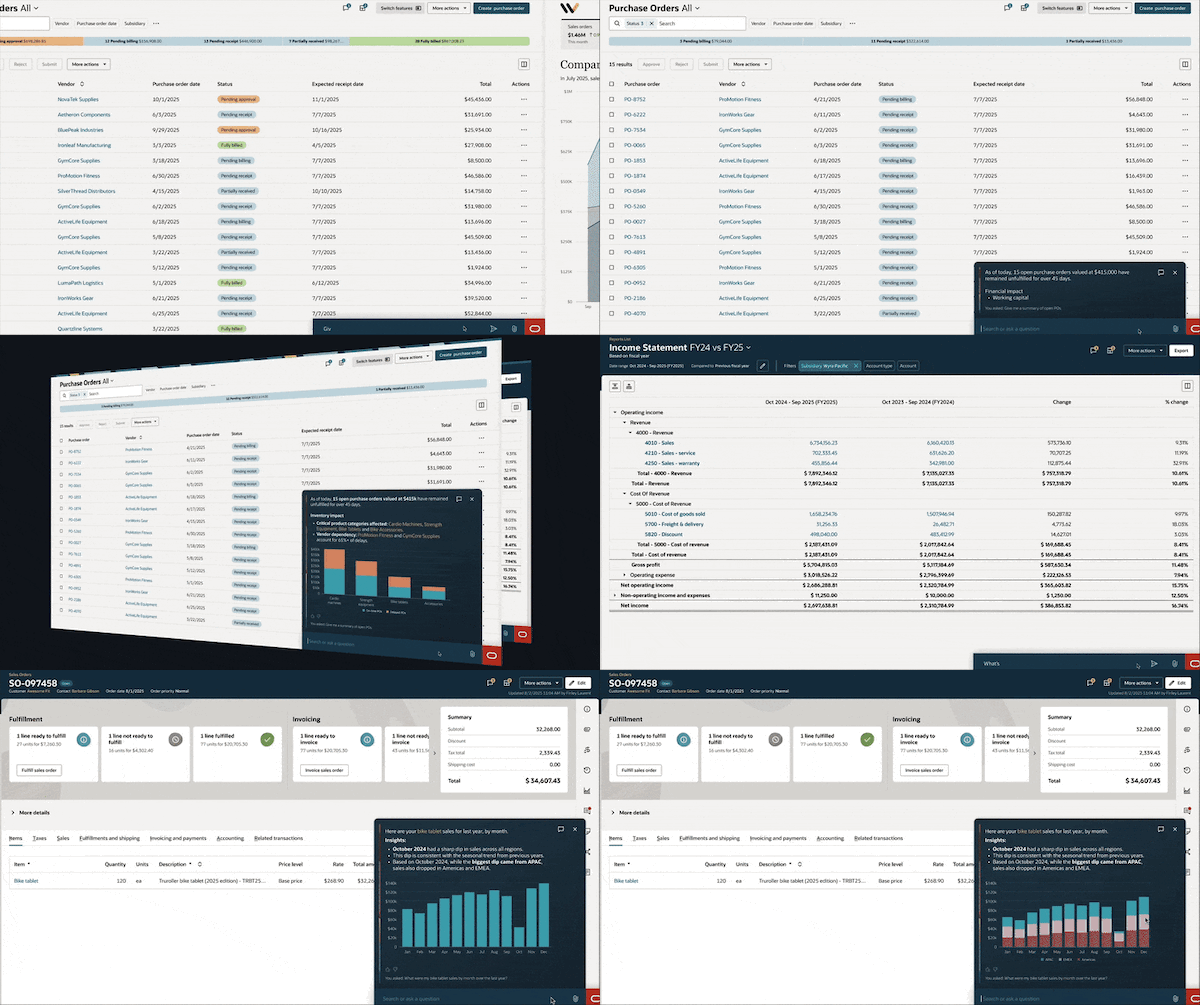
NetSuite Next is the next generation of NetSuite. It embeds conversational AI and agentic workflows across the suite to transform how AI works for business.
What makes this different is the shift in how NetSuite is intended to be used. Rather than acting purely as a system that records transactions and produces reports, NetSuite Next is designed to reason over data, explain outcomes and help initiate next steps. Users move from navigating menus and dashboards to asking questions, reviewing AI-supported recommendations and approving actions within defined controls.
ANZ timing: expected as part of the second regional rollout wave, currently anticipated between late 2026 and 2027.
Ask Oracle as a conversational interface
Ask Oracle is a natural language interface built directly into NetSuite. It allows users to search, analyse and act using plain language rather than reports, menus or saved searches. Questions such as “Why did margins fall in Q3?” or “Which invoices are waiting for approval?” return visual results, narrative explanations and the reasoning behind them.
The big shift here is how it fits into day-to-day work. Ask Oracle understands user role and context. A CFO asking about margins will see profitability drivers and trends, while an operations manager may see fulfilment or cost issues. In many cases, the response doesn’t stop at insight. Ask Oracle can also initiate actions, such as triggering approvals or updating records, within existing controls.
NetSuite intends Ask Oracle to become a primary way users interact with NetSuite, reducing the need to navigate dashboards or build one-off reports to answer routine questions.
ANZ timing: available as part of NetSuite Next, aligned to the regional rollout.
Agentic workflows from assisted steps to autonomous flow
Agentic workflows are NetSuite’s move beyond rule-based automation. Instead of automating individual steps, these workflows use AI agents to manage entire processes end to end, within defined policies and approval controls.
This means NetSuite can suggest, assemble or execute multi-step workflows such as payment runs, account reconciliations or vendor selection. The system evaluates context, applies business rules and proposes an outcome. Users then review, adjust or approve the recommendation, or allow the workflow to run automatically where risk is low and controls are clear.
For day-to-day operations, this reduces the administrative load that still sits between systems, approvals and spreadsheets. Workflows don’t stall waiting for manual intervention and exceptions are surfaced early rather than discovered at month-end.
ANZ timing: agentic capabilities will roll out progressively as part of NetSuite Next, with initial use cases focused on finance operations and payments.
AI Canvas for planning, modelling and execution
AI Canvas is a new collaborative workspace inside NetSuite designed to bring planning, analysis and execution into a single environment. It sits on top of live NetSuite data and allows teams to explore scenarios, test assumptions and act on decisions without exporting data to spreadsheets or slide decks.
Within AI Canvas, users can adjust variables such as pricing, costs or volumes and immediately see the downstream impact across financial and operational metrics. When a decision is agreed, the same workspace can be used to trigger workflows, approvals or system updates, closing the gap between analysis and action.
For organisations where planning cycles are slow or heavily spreadsheet-driven, AI Canvas can help them move from fixed quarterly or annual exercises to continuous planning.
ANZ timing: available as part of NetSuite Next, aligned to the regional rollout.
Autonomous Close and continuous accounting
Autonomous Close is NetSuite’s approach to rethinking the month-end close as an ongoing process rather than a compressed, high-pressure event. It builds on existing Close Management capabilities by using AI to monitor transactions continuously, reconcile accounts automatically and flag exceptions as they occur.
Instead of waiting until period end to identify issues, the system detects anomalies, missing entries and reconciliation problems in near real time. A central Close Manager view shows what has been completed, what is running automatically and where human review is required. Finance teams can then do less mechanical processing and focus more on exceptions and judgement.
Oracle NetSuite has indicated that internal testing achieved very high levels of automation. Even without full autonomy, the shift towards continuous accounting has the potential to materially reduce close time and stress for finance teams.
ANZ timing: available as part of NetSuite Next, aligned to the regional rollout.
The Redwood user experience
Alongside the AI capabilities, NetSuite Next builds on Oracle’s Redwood user experience. While the full Redwood interface becomes standard with NetSuite Next, ANZ customers have already seen elements of it rolling out across the suite.
Today, Redwood design patterns are live in areas such as dashboards, analytics visualisations, expenses, CRM workspaces and selected financial screens. Many users will already recognise the cleaner layouts, updated navigation, improved accessibility and early theming options that have appeared progressively over recent releases.
NetSuite Next extends this foundation into a fully consistent interface designed to support conversational AI, agent-driven workflows and collaborative workspaces. As NetSuite introduces more AI-led interactions, a simpler and more consistent interface will make those capabilities easier to adopt and harder to ignore.
ANZ timing: Redwood has been rolling out incrementally and is expected to become the standard experience as part of the NetSuite Next rollout.
SuiteAgents and the AI Connector opening NetSuite’s AI layer
This is one of the more significant NetSuite AI announcements, yet it has received relatively little attention outside technical circles.
While NetSuite Next focuses on AI embedded into standard workflows, SuiteAgents and the AI Connector are about extensibility. They allow organisations and partners to introduce their own AI logic into NetSuite while staying inside the platform’s security and governance model.
The NetSuite AI Connector Service supports the Model Context Protocol, which allows external AI models to analyse NetSuite data and take action using existing roles, permissions and approval structures. SuiteAgents build on this by enabling purpose-built AI agents to operate within NetSuite workflows, rather than alongside them.
This means AI can be layered over existing processes instead of replacing them. Examples include agents that flag revenue leakage, suggest credit decisions, identify unusual transaction patterns or support operational dispatch logic. The intelligence sits on top of the workflow teams already use.
Importantly, actions are constrained by NetSuite’s governance framework, keeping humans in the loop and ensuring AI recommendations are visible, auditable and reversible.
Availability: the AI Connector is available now, with SuiteAgents expanding through 2025–26 and aligning with broader NetSuite Next availability.
How to prepare for NetSuite AI in 2026
For most organisations, the right approach to NetSuite AI in 2026 is neither waiting for everything to arrive nor rushing into adoption without a plan. The next 6–12 months are about understanding what’s already available, tightening foundations and identifying where AI will genuinely change how work gets done.
Some steps you can take now include:
- Get familiar with the AI features already live in your NetSuite environment, particularly in analytics, planning and close, before focusing on what’s coming next.
- Join upcoming Annexa webinars covering NetSuite AI capabilities to see how these features work in practice and where they deliver real value – keep an eye on our monthly newsletter and LinkedIn page.
- Speak with Annexa’s customer success team to understand which AI-driven features are available in ANZ today and which are relevant to your setup and industry.
- Consider requesting a NetSuite optimisation review. For many organisations, this is the right moment to assess data quality, reporting structures and workflow design.
- If you are not an Annexa customer, you can reach out to sales to discuss a NetSuite optimisation or to talk about migrating to NetSuite.
The organisations that will benefit most from NetSuite AI won’t necessarily be the ones that adopt everything first. They’ll be the ones that prepare deliberately and apply it where it actually changes decisions. And Annexa is here to help you make the year AI truly delivers for your organisation!
If NetSuite AI has been on your radar, here are a few more resources that will help:
- Webinar replay: AI outlook for finance – what every CFO needs to know >
- Free guide: Building an AI in finance strategy – A business leader’s guide to unlocking AI’s potential in finance >
- The future of finance – AI capabilities you need to know with Annexa Director, Jarred Spriggs >
- Why finance is late to the AI conversation and why that’s about to change >